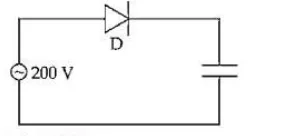
An a.c. source of 200 V is connected through a diode 'D' to a capacitor as shown in figure. Find the maximum potential difference across the capacitor:
Correct Answer :
283 V
Solution :
The correct option is 283 V.
1. Circuit Analysis from the Diagram:
From the given circuit diagram, we can observe an alternating current (a.c.) source labeled as 200 V, a diode labeled as D, and a capacitor connected in series. The diode only allows current to flow in one direction (when it is forward-biased).
2. Working of the Diode and Capacitor:
During the positive half-cycle of the a.c. input voltage, the diode D is forward-biased and conducts, allowing the capacitor to charge. The capacitor charges up to the maximum potential difference, which corresponds to the peak voltage of the a.c. source. During the negative half-cycle, the diode becomes reverse-biased and stops conducting, preventing the capacitor from discharging. Hence, the capacitor retains its charge and maintains a potential difference equal to the peak voltage of the a.c. source.
3. Calculation:
The voltage of the a.c. source is given as 200 V, which represents the root mean square (r.m.s.) value:
The peak voltage of the a.c. source is related to the r.m.s. voltage by the following equation:
Substitute the given r.m.s. voltage into the equation:
Using the value of the square root of 2:
Calculate the peak voltage:
Therefore, the maximum potential difference across the capacitor is 283 V.
Access expert-curated educational resources and study materials—completely free.
Create, conduct, and manage professional online assessments with Mindyard. Perfect for teachers and institutes.
Copyright © 2026 Mindyard. All Rights Reserved.