An analytic function f(z) of complex variable z = x + I y may be written as f(z) = u(x, y) + iv (x, y). Then, u(x, y) and v(x, y) must satisfy
Options
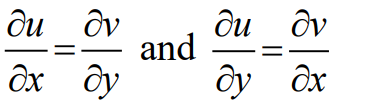
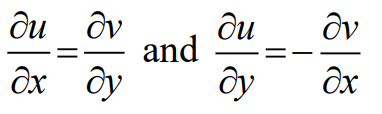
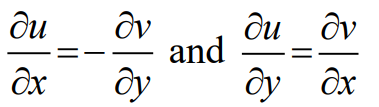
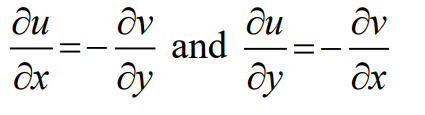
Correct Answer :
Solution :
The correct answer is:
and
Step-by-Step Explanation:
1. Definition of analyticity:
A complex-valued function defined on a domain in the complex plane is analytic (or holomorphic) if it is complex-differentiable at every point in that domain.
2. Differentiability condition:
The derivative of with respect to is defined as:
For the derivative to exist, the limit must be the same regardless of the path along which approaches 0.
3. Approaching along the real axis ():
If we approach the limit horizontally so that , the derivative is:
4. Approaching along the imaginary axis ():
If we approach the limit vertically so that , the derivative is:
5. Equating the real and imaginary parts:
For to be uniquely defined, the expressions obtained from both paths must be equal:
Equating the real parts gives:
Equating the imaginary parts gives:
These are the fundamental partial differential equations known as the Cauchy-Riemann equations, which are represented in the second option (image_1.png).
Access expert-curated educational resources and study materials—completely free.
Create, conduct, and manage professional online assessments with Mindyard. Perfect for teachers and institutes.
Copyright © 2026 Mindyard. All Rights Reserved.