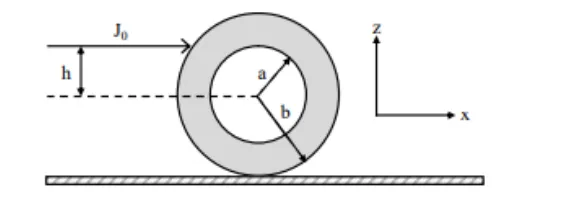
An annular disk of mass M, inner radius a, and outer radius b is placed on a horizontal surface with a coefficient of friction µ, as shown in the figure. At some time, an impulse is applied at a height h above the center of the disk. If h = hm, then the disk rolls without slipping along the x-axis. Which of the following statement(s) is/are correct?
Correct Answer :
For μ ≠ 0 and a → 0,
For μ ≠ 0 and a → b, hm = b
For h = hm, the initial angular velocity does not depend on the inner radius a.
For μ = 0 and h = 0, the wheel always slides without rolling.
Solution :
Correct Options:
1. For μ ≠ 0 and a → 0,
2. For μ ≠ 0 and a → b, hm = b
3. For h = hm, the initial angular velocity does not depend on the inner radius a.
4. For μ = 0 and h = 0, the wheel always slides without rolling.
Detailed Step-by-Step Solution:
Let an annular disk of mass , inner radius , and outer radius be placed on a horizontal surface. An impulse is applied horizontally at a height above the center of the disk.
1. Moment of Inertia of an Annular Disk:
The moment of inertia of the annular disk about its central axis perpendicular to its plane is given by:
2. Linear and Angular Impulse Equations:
Let be the initial linear velocity of the center of mass right after the impulse, and be the initial angular velocity.
Linear impulse-momentum relation along the x-axis gives:
Angular impulse-angular momentum relation about the center of mass gives:
3. Condition for Pure Rolling Immediately After Impulse:
For pure rolling without slipping along the surface immediately after the impulse, the bottom-most point in contact with the ground must have zero velocity. Thus:
Substituting and :
Solving for :
4. Evaluating the Given Options:
Option 1: For and solid disk limit ():
Hence, Statement 1 is correct.
Option 2: For and thin ring limit ():
Hence, Statement 2 is correct.
Option 3: When , since pure rolling is established immediately, we have:
As seen, depends only on , , and , and does not depend on the inner radius . Hence, Statement 3 is correct.
Option 4: For smooth surface () and impulse applied through the center of mass ():
The torque about the center of mass is zero (), so . Since there is no friction (), no torque can ever be exerted on the disk. Thus, it only translates with velocity without rotating (), meaning the wheel always slides without rolling. Hence, Statement 4 is correct.
Access expert-curated educational resources and study materials—completely free.
Create, conduct, and manage professional online assessments with Mindyard. Perfect for teachers and institutes.
Copyright © 2026 Mindyard. All Rights Reserved.