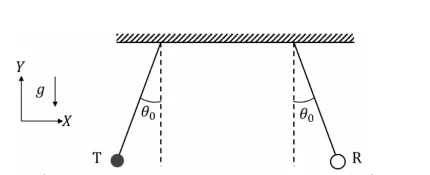
Correct Answer :
Solution :
The correct answer is 32.01.
1. Find the Maximum Velocity of the Transmitter and Receiver:
Both the transmitter and receiver act as simple pendulums of length , released from an initial angular displacement of where .
Using the law of conservation of mechanical energy, the maximum velocity of each pendulum at its lowest point is given by:
where is the maximum vertical height reached by the pendulum. Thus:
Substituting the given values , , and :
2. Determine the Doppler Shifted Frequencies:
Since the two pendulums are pulled in opposite directions and released simultaneously, their motions are out of phase. When one pendulum is at its lowest point moving to the right, the other is at its lowest point moving to the left.
The maximum frequency is detected when the transmitter and receiver are moving directly toward each other with their maximum speed :
Substituting and the speed of sound :
The minimum frequency is detected when the transmitter and receiver are moving directly away from each other with their maximum speed:
3. Calculate the Maximum Variation in Frequency:
The maximum frequency variation is:
Rounding to two decimal places, the maximum variation in the frequency is 32.01 Hz.
Access expert-curated educational resources and study materials—completely free.
Create, conduct, and manage professional online assessments with Mindyard. Perfect for teachers and institutes.
Copyright © 2026 Mindyard. All Rights Reserved.