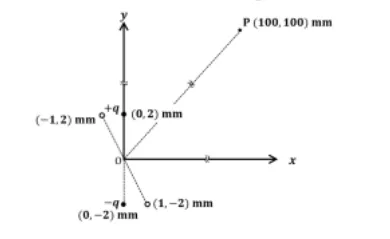
An electric dipole is formed by two charges +q and −q located in the xy-plane at (0, 2) mm and (0, −2) mm, respectively, as shown in the figure. The electric potential at point P(100, 100) mm due to the dipole is V0. The charges +q and −q are then moved to the points (−1, 2) mm and (1, −2) mm, respectively. What is the value of the electric potential at P due to the new dipole?
Correct Answer :
Solution :
Correct Answer:
Step 1: Understand the formula for electric potential due to a short electric dipole
The electric potential at a far point (with position vector ) due to an electric dipole having dipole moment vector located at the origin is given by:
Since point mm is at a much larger distance compared to the dimensions of the dipole (a few millimeters), we can treat it as a short electric dipole centered near the origin.
Step 2: Calculate the initial dipole moment and potential
Initially, charge is at mm and charge is at mm.
The position vector pointing from to is:
Thus, the initial dipole moment vector is:
The position vector of point relative to the origin is:
Taking the dot product :
Therefore, the initial potential is proportional to :
(where )
Step 3: Calculate the new dipole moment and potential
As shown in the figure, the charges are moved such that is at mm and is at mm.
The new displacement vector from to is:
The new dipole moment vector is:
Taking the dot product :
The new potential at point is:
Step 4: Relate the new potential to
Comparing with :
Hence, the value of the electric potential at point due to the new dipole is .
Access expert-curated educational resources and study materials—completely free.
Create, conduct, and manage professional online assessments with Mindyard. Perfect for teachers and institutes.
Copyright © 2026 Mindyard. All Rights Reserved.