
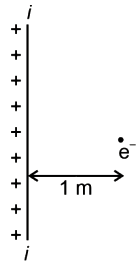
An electron is moving with speed of 1 m/s at distance of 1 m from a large sheet of charge with density σ C/m2 . Find maximum value of σ such that electron hit the sheet after 1 sec. (mass of electron 9 × 10–31 kg, permittivity of free space ε0 = 9 × 10–12 C2 /Nm2)
Solution :
The correct answer is 4.05 × 10⁻²² C/m2.
1. Understanding the Physical System:
We are given a large sheet of charge with a positive surface charge density and an electron located at a distance of 1 m from the sheet, as shown in the diagram below:
Since the sheet is positively charged, it produces a uniform electric field directed away from it. The magnitude of this electric field is:
The electron (which has a negative charge ) experiences an electrostatic force directed towards the sheet. The magnitude of this force is:
Using Newton's second law, the constant acceleration of the electron towards the sheet is:
2. Equation of Motion and Maximum Limit:
Let us set up a coordinate system where the sheet lies at and the direction away from the sheet is the positive x-direction. The initial position of the electron is .
Since the acceleration is directed towards the sheet, we have:
The position of the electron at any time is given by the kinematic equation:
To maximize the time taken to hit the sheet (), the electron's initial velocity should be directed straight away from the sheet, so .
Setting at the limiting time :
Simplifying this equation:
3. Calculating the Surface Charge Density:
We can now solve for the maximum value of using the relation:
Substituting the given constants:
Calculating the numerator:
Dividing by the charge of the electron:
Completely free for students. Educators & coaching institutes get 2 months free Pro trial to create tests.
Access unlimited practice questions, detailed step-by-step solutions, and exam study materials — completely free for students.
Create and conduct professional online assessments with AI question generation, tab proctoring, and comprehensive batch management.

A comprehensive JEE Advanced 2022 Paper 1 designed to help aspirants understand the examination pattern, difficulty level, and question trends of JEE Advanced. This paper covers important concepts from Physics, Chemistry, and Mathematics, featuring a balanced mix of conceptual, numerical, and advanced application-based questions. It helps students strengthen conceptual understanding, enhance analytical and problem-solving skills, and improve speed and accuracy. Ideal for practice, revision, self-assessment, previous year trend analysis, concept reinforcement, and time management, this paper is a valuable resource for effective JEE Advanced preparation.

A comprehensive JEE Advanced 2022 Paper 2 designed to help aspirants understand the examination pattern, difficulty level, and question trends of JEE Advanced. This paper covers important concepts from Physics, Chemistry, and Mathematics, featuring a balanced mix of conceptual, numerical, and advanced application-based questions. It helps students strengthen conceptual understanding, enhance analytical and problem-solving skills, and improve speed and accuracy. Ideal for practice, revision, self-assessment, previous year trend analysis, concept reinforcement, and time management, this paper is a valuable resource for effective JEE Advanced preparation.
Copyright © 2026 Combe Labs Private Limited. All Rights Reserved.


