An engine running on an air standard Otto cycle has a displacement volume 250 cm3 and a clearance volume 35.7 cm3 . The pressure and temperature at the beginning of the compression process are 100 kPa and 300 K, respectively. Heat transfer during constant volume heat addition process is 800 kJ/kg. The specific heat at constant volume is 0.718 kJ/kg.K and the ratio of specific heats at constant pressure and constant volume is 1.4. Assume the specific heats to remain constant during the cycle. The maximum pressure in the cycle is ______ kPa (round off to the nearest integer).
Correct Answer :
Correct answer is : 4811
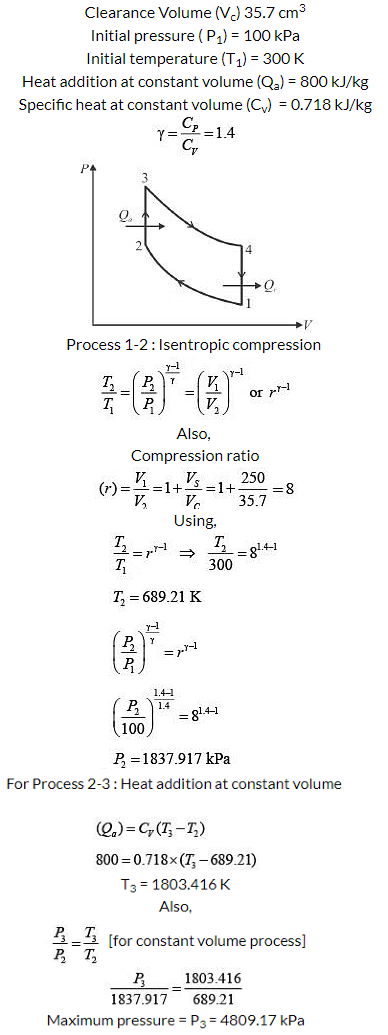
Solution :
The correct answer is 4811.
1. Analysis of the Otto Cycle Parameters:
Based on the provided PV diagram and problem parameters, we identify the state points and properties of the engine cycle:
Displacement volume,
Clearance volume,
Initial pressure (at point 1),
Initial temperature (at point 1),
Heat transfer during constant volume heat addition (process 2-3),
Specific heat at constant volume,
Ratio of specific heats,
2. Compression Ratio ():
The compression ratio is defined as the ratio of maximum volume to minimum volume:
3. Isentropic Compression Process (1-2):
Using the relation for temperature during isentropic compression:
Using the relation for pressure during isentropic compression:
4. Constant Volume Heat Addition Process (2-3):
The heat transfer during the constant volume process is given by:
Substituting the given values to find the maximum temperature ():
5. Maximum Pressure in the Cycle ():
In the Otto cycle, the maximum pressure occurs at the end of the constant volume heat addition process (state 3). For a constant volume process (2-3):
Rounding to the nearest integer, we find the maximum pressure in the cycle is 4811 kPa.
Access expert-curated educational resources and study materials—completely free.
Create, conduct, and manage professional online assessments with Mindyard. Perfect for teachers and institutes.
Copyright © 2026 Mindyard. All Rights Reserved.