Correct Answer :
Solution :
The correct answer is 1.6.
Step 1: Understand the processes shown in the V-T diagram
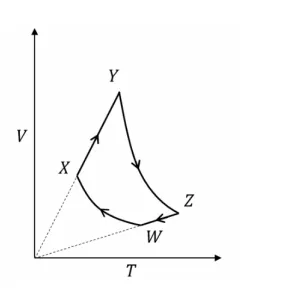
In the given volume-temperature (V-T) diagram:
- The processes and are adiabatic processes.
- The processes and are represented by straight lines pointing toward the origin, which means volume is directly proportional to temperature (). Thus, these are isobaric (constant pressure) processes.
We are given the following values:
- Volume at point ,
- Volume at point ,
- Volume at point ,
- Universal gas constant relation at ,
Step 2: Analyze the adiabatic process W-X
For a quasi-static adiabatic process of an ideal gas, the relation between temperature and volume is given by:
For an ideal monatomic gas, the ratio of specific heats is:
Applying this relation between points and :
Solving for :
Substitute the given volumes:
Multiplying by :
Step 3: Analyze the isobaric process X-Y
Since the process is isobaric, we have:
Substitute the given volumes:
Multiplying by :
Step 4: Calculate the heat absorbed along path X-Y
The heat absorbed at constant pressure () is given by:
For a monatomic gas, the molar heat capacity at constant pressure is . Therefore:
Substituting the values of and :
Access expert-curated educational resources and study materials—completely free.
Create, conduct, and manage professional online assessments with Mindyard. Perfect for teachers and institutes.
Copyright © 2026 Mindyard. All Rights Reserved.