
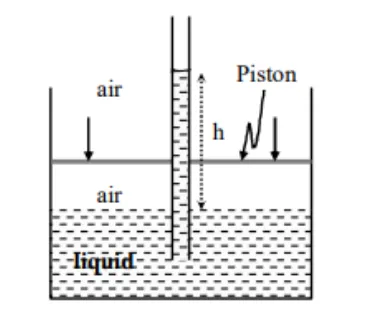
An incompressible liquid is kept in a container having a weightless piston with a hole. A capillary tube of inner radius 0.1 mm is dipped vertically into the liquid through the airtight piston hole, as shown in the figure. The air in the container is isothermally compressed from its original volume V0 to with the movable piston. Considering air as an ideal gas, the height (h) of the liquid column in the capillary above the liquid level in cm is ______.
[Given: Surface tension of the liquid is 0.075 N m−1, atmospheric pressure is 105 N m−2, acceleration due to gravity (g) is 10 m s−2, density of the liquid is 103 kg m−3 and contact angle of capillary surface with the liquid is zero
Solution :
The correct answer is 25.
Step 1: Understand the physical situation and given data
An incompressible liquid is contained in a vessel fitted with an airtight movable piston. Trapped air of original volume exists between the liquid surface and the piston inside the container. Atmospheric pressure outside acts on the top, which is .
The given data values are:
- Inner radius of the capillary tube,
- Initial air pressure inside the container,
- Initial air volume inside the container,
- Final air volume inside the container after compression,
- Surface tension of the liquid,
- Acceleration due to gravity,
- Density of liquid,
- Angle of contact,
Step 2: Calculate the new pressure of the compressed air
Since the air in the container undergoes isothermal compression ():
Substituting and :
The increase in air pressure inside the container above atmospheric pressure is:
Substituting :
Step 3: Analyze the liquid height in the capillary tube
As indicated in the figure, the height of the liquid column inside the capillary is measured relative to the liquid level inside the container.
The pressure at the liquid surface inside the container is equal to the compressed air pressure, .
The top open end of the capillary tube is exposed to the atmosphere outside the piston where the pressure is .
Due to surface tension, the pressure jump across the curved meniscus inside the capillary tube is .
Equating the pressure at the liquid level inside the container from both sides:
Rearranging the equation yields:
Step 4: Calculate the individual excess pressure components
1. Pressure difference due to compression:
2. Capillary excess pressure term:
Summing these gives the total effective pressure head driving the liquid up:
Step 5: Solve for the height
Converting meters to centimeters:
Thus, the height of the liquid column in the capillary above the liquid level is 25 cm.
Completely free for students. Educators & coaching institutes get 2 months free Pro trial to create tests.
Access unlimited practice questions, detailed step-by-step solutions, and exam study materials — completely free for students.
Create and conduct professional online assessments with AI question generation, tab proctoring, and comprehensive batch management.

A comprehensive JEE Advanced 2022 Paper 1 designed to help aspirants understand the examination pattern, difficulty level, and question trends of JEE Advanced. This paper covers important concepts from Physics, Chemistry, and Mathematics, featuring a balanced mix of conceptual, numerical, and advanced application-based questions. It helps students strengthen conceptual understanding, enhance analytical and problem-solving skills, and improve speed and accuracy. Ideal for practice, revision, self-assessment, previous year trend analysis, concept reinforcement, and time management, this paper is a valuable resource for effective JEE Advanced preparation.

A comprehensive JEE Advanced 2022 Paper 2 designed to help aspirants understand the examination pattern, difficulty level, and question trends of JEE Advanced. This paper covers important concepts from Physics, Chemistry, and Mathematics, featuring a balanced mix of conceptual, numerical, and advanced application-based questions. It helps students strengthen conceptual understanding, enhance analytical and problem-solving skills, and improve speed and accuracy. Ideal for practice, revision, self-assessment, previous year trend analysis, concept reinforcement, and time management, this paper is a valuable resource for effective JEE Advanced preparation.
Copyright © 2026 Combe Labs Private Limited. All Rights Reserved.


