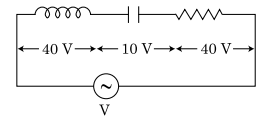
An inductor of inductance L, a capacitor of capacitance C and a resistor of resistance ‘R’ are connected in series to an ac source of potential difference ‘V’ volts as shown in figure. Potential difference across L, C and R is 40 V, 10 V and 40 V, respectively. The amplitude of current flowing through LCR series circuit is 10√2 A. The impedance of the circuit is :
Correct Answer :
5 Ω
Solution :
**Step 1 – Find the phasor values of the individual voltages**
The given potentials are peak (amplitude) values:
In a series LCR circuit the resistor voltage is in phase with the current, the inductor voltage leads the current by 90°, and the capacitor voltage lags the current by 90°. Hence the net reactive voltage is the difference between the inductor and capacitor voltages:
**Step 2 – Resultant peak voltage of the source**
Using the right‑triangle of the phasor diagram, the magnitude of the total source voltage (peak) is
**Step 3 – Convert the current to its RMS value**
The problem states that the current amplitude (peak) is
Therefore the RMS current is
**Step 4 – Calculate the magnitude of the impedance**
Impedance magnitude is the ratio of RMS voltage to RMS current. The RMS voltage corresponding to the peak value found in Step 2 is
Thus
**Result**: the impedance of the series LCR circuit is **5 Ω**.
Access expert-curated educational resources and study materials—completely free.
Create, conduct, and manage professional online assessments with Mindyard. Perfect for teachers and institutes.
Copyright © 2026 Mindyard. All Rights Reserved.