Question Details

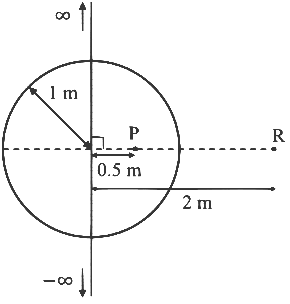
An infinitely long thin wire, having a uniform charge density per unit length of 5 nC/m, is passing through a spherical shell of radius 1 m, as shown in the figure. A 10 nC charge is distributed uniformly over the spherical shell. If the configuration of the charges remains static, the magnitude of the potential difference between points P and R, in Volt, is ______.

[Given: In SI units 1 4 π ϵ 0 = 9 × 10 9 , ln  2 = 0.7 . Ignore the area pierced by the wire.]

Show Answer

Correct Answer :

171

Solution :

The correct answer is 171.

1. Analysis of the Image and Given Parameters:
Based on the provided diagram:

  • An infinitely long thin wire runs vertically through the center of a spherical shell of radius Rs=1 m.
  • The linear charge density of the wire is λ=5 nC/m=5×10-9 C/m.
  • The spherical shell carries a uniformly distributed charge of Q=10 nC=10×10-9 C.
  • Point P lies at a perpendicular distance of rP=0.5 m from the wire, which is inside the spherical shell since rP<Rs.
  • Point R lies at a perpendicular distance of rR=2 m from the wire, which is outside the spherical shell since rR>Rs.
By the principle of superposition, the total electric potential at any point is the sum of the potentials due to the spherical shell and the infinite wire:
V=Vshell+Vwire

2. Potential Difference due to the Spherical Shell:
For a uniformly charged spherical shell:

  • Inside the shell (r<Rs), the potential is constant and equal to its value at the surface:
Vshell(P)=14πϵ0QRs
Substituting the given values:
Vshell(P)=(9×109)×10×10-91=90 V
  • Outside the shell (r>Rs), the potential is equivalent to that of a point charge located at the center:
Vshell(R)=14πϵ0QrR
Substituting the given values:
Vshell(R)=(9×109)×10×10-92=45 V
Thus, the contribution of the shell to the potential difference between points P and R is:
ΔVshell=Vshell(P)-Vshell(R)=90-45=45 V

3. Potential Difference due to the Infinitely Long Wire:
The electric field at a distance r from an infinitely long wire with linear charge density λ is:
E(r)=λ2πϵ01r
The potential difference between points P and R due to the wire is:
Vwire(P)-Vwire(R)=rPrRE(r)dr=λ2πϵ0ln(rRrP)
Using the relation 12πϵ0=2×14πϵ0=18×109 N m2/C2:
Vwire(P)-Vwire(R)=(18×109)×(5×10-9)×ln(20.5)
Vwire(P)-Vwire(R)=90×ln(4)=90×2ln(2)=180ln(2)
Given that ln(2)=0.7:
Vwire(P)-Vwire(R)=180×0.7=126 V

4. Total Potential Difference:
The total potential difference between points P and R is:
V(P)-V(R)=[Vwire(P)-Vwire(R)]+[Vshell(P)-Vshell(R)]
V(P)-V(R)=126+45=171 V
Therefore, the magnitude of the potential difference between points P and R is 171 V.

Unlock Our Free Library

Access expert-curated educational resources and study materials—completely free.

Discover more resources

You may also like

Mock Tests

View All
  • JEE
  • intermediate
  • 3 hours
  • chemistry, mathematics, physics
  • Proctored

  • JEE
  • intermediate
  • 3 hours
  • chemical engineering, mathematics, physics

Ask AI Tutor
5 left
Q1 View Question & Options
AI Tutor is solving this question...
Reading question context & options...