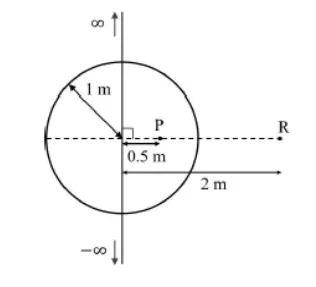
An infinitely long thin wire, having a uniform charge density per unit length of 5nC/m , is passing through a spherical shell of radius 1m , as shown in the figure. A 10nC charge is distributed uniformly over the spherical shell. If the configuration of the charges remains static, the magnitude of the potential difference between points P and R, in Volt, is
Correct Answer :
Solution :
The correct answer is 171.
1. Understanding the Given Configuration and Data:
From the question and the provided figure, we have:
• Radius of the spherical shell, .
• Uniform charge on the spherical shell, .
• Linear charge density of the infinitely long wire, .
• Point is located inside the spherical shell at a perpendicular distance from the wire.
• Point is located outside the spherical shell at a perpendicular distance from the wire.
• The line connecting the center of the shell to points and is perpendicular to the wire, passing through the center of the sphere.
• Given values: and .
2. Superposition Principle for Potential:
By the principle of superposition, the net potential at any point is the sum of the potential due to the spherical shell and the potential due to the infinite wire:
3. Electric Potential due to the Spherical Shell:
• Since point is inside the spherical shell (), the potential inside a uniformly charged thin spherical shell is constant and equal to the potential on its surface:
• Point is outside the spherical shell (), so the potential outside is given by:
Thus, the potential difference contributed by the shell is:
Substituting the numerical values:
4. Electric Potential Difference due to the Infinite Wire:
The potential difference between two points at perpendicular distances and from an infinitely long wire of uniform charge density is given by:
We can rewrite .
Substituting the given values into the equation:
Using :
5. Calculating Total Potential Difference:
The magnitude of the potential difference between points and is:
Access expert-curated educational resources and study materials—completely free.
Create, conduct, and manage professional online assessments with Mindyard. Perfect for teachers and institutes.
Copyright © 2026 Mindyard. All Rights Reserved.