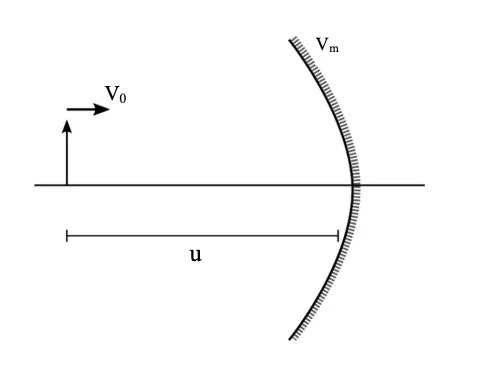
An object and a concave mirror of focal length both move along the principal axis of the mirror with constant speeds. The object moves with speed towards the mirror with respect to a laboratory frame. The distance between the object and the mirror at a given moment is denoted by u. When , the speed of the mirror is such that the image is instantaneously at rest with respect to the laboratory frame, and object forms a real image. The magnitude of is _____cm s−1.
Correct Answer :
Solution :
The correct answer is 3.
Step-by-step Explanation:
As shown in the given diagram, an object moves to the right towards a concave mirror with a speed relative to the laboratory frame. The distance between the object and the mirror is given as , and the focal length of the concave mirror is .
1. Using the Mirror Formula to find the image distance (v):
According to the Cartesian sign convention, with the direction of incident light taken as positive (to the right):
Object distance,
Focal length of concave mirror,
The mirror formula is:
Substituting the values into the formula:
Thus, .
2. Relation between velocities:
Differentiating the mirror formula with respect to time :
Here, is the velocity of the image with respect to the mirror, and is the velocity of the object with respect to the mirror.
Let , , and be the velocities of the image, object, and mirror relative to the laboratory frame, respectively:
3. Calculating the magnitude of :
Given that the image is instantaneously at rest in the laboratory frame, .
The object is moving to the right, so .
Also, .
Substitute these values into the velocity equation:
Thus, the magnitude of is 3 cm s−1.
Access expert-curated educational resources and study materials—completely free.
Create, conduct, and manage professional online assessments with Mindyard. Perfect for teachers and institutes.
Copyright © 2026 Mindyard. All Rights Reserved.