An opaque pyramid (shown below), with a square base and isosceles faces, is suspended in the path of a parallel beam of light, such that its shadow is cast on a screen oriented perpendicular to the direction of the light beam. The pyramid can be reoriented in any direction within the light beam. Under these conditions, which one of the shadows P, Q, R, and S is NOT possible? 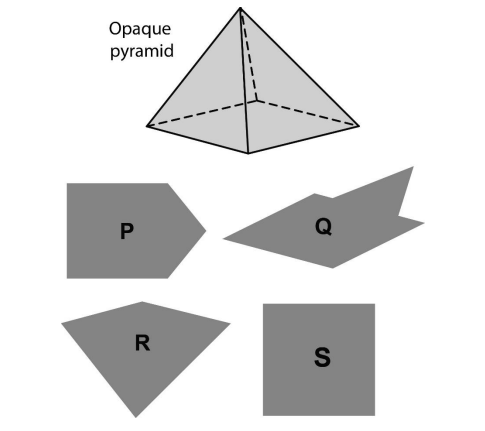
Correct Answer :
Q
Solution :
The correct option is Q.
Analysis of the Pyramid and its Shadows:
The given image shows an opaque pyramid with a square base and four isosceles triangular faces. When this pyramid is suspended in a parallel beam of light, the shadow cast on a screen perpendicular to the light beam represents the orthogonal projection of the pyramid onto a two-dimensional plane.
Geometric Principles:
1. A pyramid is a convex polyhedron. By definition, a shape is convex if any line segment connecting two points inside the shape lies entirely within it.
2. A fundamental theorem in geometry states that the orthogonal projection (or parallel shadow) of any convex three-dimensional object onto a plane must always be a convex two-dimensional polygon.
3. In a convex polygon, all interior angles are less than or equal to:
and any line segment joining any two points within the polygon lies entirely inside it.
Evaluating the Shadow Options:
- Shadow S: This is a square, which is a convex quadrilateral. This shadow is formed when the light beam is directed perpendicular to the square base of the pyramid.
- Shadow P: This is a five-sided convex pentagon. This shadow can be formed by tilting the pyramid at an angle relative to the light beam.
- Shadow R: This is a convex kite-like shape, which can also be formed by tilting the pyramid along one of its diagonals.
- Shadow Q: Looking closely at the right side of shape Q in the image, there is a distinct V-shaped inward notch. This indicates that Q is a concave (non-convex) polygon because it contains a reflex interior angle greater than:
A convex object cannot project a concave shadow under parallel light beams.
Therefore, shadow Q is NOT possible.
Access expert-curated educational resources and study materials—completely free.
Create, conduct, and manage professional online assessments with Mindyard. Perfect for teachers and institutes.
Copyright © 2026 Mindyard. All Rights Reserved.