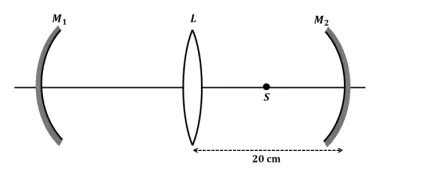
An optical arrangement consists of two concave mirrors M1 and M2, and a convex lens L with a common principal axis, as shown in the figure. The focal length of L is 10 cm. The radii of curvature of M1 and M2 are 20 cm and 24 cm, respectively. The distance between L and M2 is 20 cm. A point object S is placed at the mid-point between L and M2 on the axis. When the distance between L and M1 is cm, one of the images coincides with S. The value of n is .
Correct Answer :
Solution :
Correct Answer: The correct value of n is 220.
Step-by-Step Explanation:
Let us analyze the optical system given in the question and figure:
Given Data:
- Focal length of convex lens L:
- Radius of curvature of concave mirror M1: ⇒ Focal length
- Radius of curvature of concave mirror M2: ⇒ Focal length
- Distance between Lens L and Mirror M2 = 20 cm
- Point object S is placed at the midpoint between L and M2.
Therefore, distance of S from L = 10 cm, and distance of S from M2 = 10 cm.
Tracing the Light Rays:
Light rays from S travel in two opposite directions: towards concave mirror M2 and towards convex lens L.
1. Reflection from Mirror M2:
For mirror M2, using the mirror formula :
Object distance for M2:
Focal length of M2:
The image formed by M2 is formed at a distance of 60 cm to the left of M2 (behind the mirror/towards the lens side).
Since the distance between M2 and L is 20 cm, this virtual image acts as a real object for lens L situated to the left of L by a distance of:
(to the left of lens L).
2. Refraction through Lens L:
For lens L, using the lens formula :
Object distance for L:
Focal length of L:
So, the lens forms an image at a distance of to the left of L.
3. Condition for Image to Coincide with Object S:
Let the distance between lens L and concave mirror M1 be .
For the final image after reflection from M1 to retrace its path and coincide with S (or reform at S), the light rays hitting M1 must strike normally and reflect back along the same path, or the image formed by L must fall on the center of curvature of M1.
The center of curvature of mirror M1 is at a distance from M1.
Thus, the position of the image formed by L must be at the center of curvature of M1:
(or when measured from M1)
Wait, if the rays reflect back from M1 along the same path, they re-enter the lens and re-trace their path back to S.
Alternatively, considering direct refraction from L for rays starting from S:
Rays going left from S encounter L first:
For object S:
Focal length:
Since , rays emerging from L become parallel to the principal axis.
These parallel rays hit mirror M1 and reflect to focus at the focus of M1, which is at distance from M1.
For these rays to form an image back at S after passing through L again, the position of M1 must satisfy:
Evaluating :
Comparing with , we get:
Access expert-curated educational resources and study materials—completely free.
Create, conduct, and manage professional online assessments with Mindyard. Perfect for teachers and institutes.
Copyright © 2026 Mindyard. All Rights Reserved.