Correct Answer :
Solution :
The correct answer is:
Step-by-Step Explanation:
1. Analyze the Geometry from the Figure:
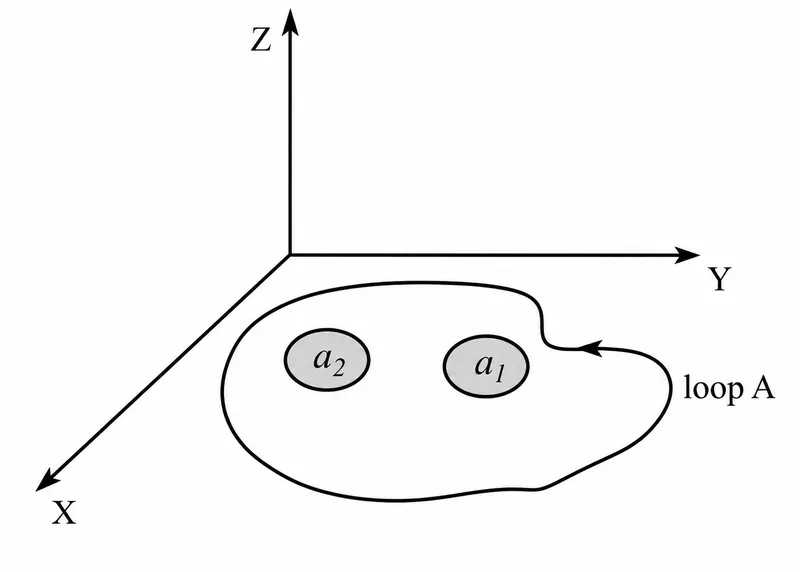
As shown in the coordinate system of the provided image, the axes are labeled X, Y, and Z. The conducting loop A lies entirely in the XY plane. Within this loop, there are two distinct, non-intersecting shaded regions labeled with areas a1 and a2.
Since the loop A lies in the XY plane, its area vector is normal to the plane, pointing along the Z-axis:
2. Determine the Magnetic Flux:
The total magnetic flux passing through the loop A is the sum of the fluxes through the two regions of area a1 and a2. Because the area vector points in the Z direction, only the z-components of the magnetic fields B1 and B2 contribute to the flux:
Given the magnetic fields:
Substituting these back into the flux equation:
3. Calculate the Induced EMF (Voltage):
By Faraday's Law of Induction, the induced EMF is:
Differentiating each term with respect to time:
4. Find the Root-Mean-Square (RMS) Voltage:
The voltage expression consists of two components at different harmonic frequencies: one at frequency and the other at frequency .
Since sine/cosine functions with different frequencies are orthogonal, the average of their cross-product over a period is zero. Thus, the total mean-square value is the sum of the mean-square values of each independent component:
For a sinusoidal term of amplitude , the average squared value is :
Combining the terms under a common denominator of 2 to match the correct option structure:
Access expert-curated educational resources and study materials—completely free.
Create, conduct, and manage professional online assessments with Mindyard. Perfect for teachers and institutes.
Copyright © 2026 Mindyard. All Rights Reserved.