
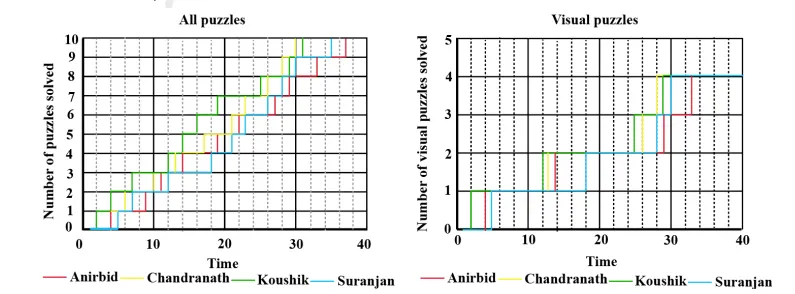
Anirbid, Chandranath, Koushik, and Suranjan participated in a puzzle solving competition. The competition comprised 10 puzzles that had to be solved in the same sequence, i.e., a competitor got access to a puzzle as soon as they solved the previous puzzle. Some of the puzzles were visual puzzles and the others were number-based puzzles. The winner of the competition was the one who solved all puzzles in the least time. The following charts describe their progress in the competition. The chart on the left shows the number of puzzles solved by each competitor at a given time (in minutes) after the start of the competition. The chart on the right shows the number of visual puzzles solved by each competitor at a given time (in minutes) after the start of the competition.
Which of the following is the closest to the average time taken by Anirbid to solve the number-based puzzles in the competition?
Correct Answer :
4.0 minutes
Solution :
The correct answer is 4.0 minutes.
Step 1: Understand the Rules and Identify the Puzzle Types
The competition consists of 10 puzzles solved sequentially (from Puzzle 1 to Puzzle 10). The charts show the total progress of the competitors ("All puzzles" on the left) and their progress on visual puzzles specifically ("Visual puzzles" on the right). By comparing the completion times of puzzles for any competitor between the two charts, we can identify which puzzles are visual and which are number-based.
Let's analyze the progress of Koushik (represented by the green line):
- He solves his 1st puzzle at 2 minutes (from the left chart), and his 1st visual puzzle is also completed at 2 minutes (from the right chart). This means Puzzle 1 is a visual puzzle.
- He solves his 4th puzzle at 12 minutes (left chart), which matches the completion of his 2nd visual puzzle at 12 minutes (right chart). Thus, Puzzle 4 is visual.
- He solves his 8th puzzle at 25 minutes (left chart), matching the completion of his 3rd visual puzzle at 25 minutes (right chart). Thus, Puzzle 8 is visual.
- He solves his 9th puzzle at 28 minutes (left chart), matching the completion of his 4th visual puzzle at 28 minutes (right chart). Thus, Puzzle 9 is visual.
Since there are 4 visual puzzles in total, the remaining 6 puzzles must be number-based. The classification is as follows:
- Visual Puzzles: Puzzles 1, 4, 8, and 9.
- Number-Based Puzzles: Puzzles 2, 3, 5, 6, 7, and 10.
Step 2: Track Anirbid's Puzzle Completion Times
Now, we look at Anirbid's progress, represented by the red/brown line in the "All puzzles" chart, to find the completion time of each puzzle:
- Puzzle 1 (Visual) is completed at:
- Puzzle 2 (Number) is completed at:
- Puzzle 3 (Number) is completed at:
- Puzzle 4 (Visual) is completed at:
- Puzzle 5 (Number) is completed at:
- Puzzle 6 (Number) is completed at:
- Puzzle 7 (Number) is completed at:
- Puzzle 8 (Visual) is completed at:
- Puzzle 9 (Visual) is completed at:
- Puzzle 10 (Number) is completed at:
Step 3: Calculate the Time Taken for Each Number-Based Puzzle
The time taken to solve a puzzle is the difference between its completion time and the completion time of the preceding puzzle:
- Time taken for Puzzle 2:
- Time taken for Puzzle 3:
- Time taken for Puzzle 5:
- Time taken for Puzzle 6:
- Time taken for Puzzle 7:
- Time taken for Puzzle 10:
Step 4: Compute the Average Time
Sum the individual times taken by Anirbid to solve all 6 number-based puzzles:
Now, divide by the number of number-based puzzles (6) to find the average:
Access expert-curated educational resources and study materials—completely free.
Create, conduct, and manage professional online assessments with Mindyard. Perfect for teachers and institutes.
Copyright © 2026 Mindyard. All Rights Reserved.




