
Anirbid, Chandranath, Koushik, and Suranjan participated in a puzzle solving competition. The competition comprised 10 puzzles that had to be solved in the same sequence, i.e., a competitor got access to a puzzle as soon as they solved the previous puzzle. Some of the puzzles were visual puzzles and the others were number-based puzzles. The winner of the competition was the one who solved all puzzles in the least time. The following charts describe their progress in the competition. The chart on the left shows the number of puzzles solved by each competitor at a given time (in minutes) after the start of the competition. The chart on the right shows the number of visual puzzles solved by each competitor at a given time (in minutes) after the start of the competition.
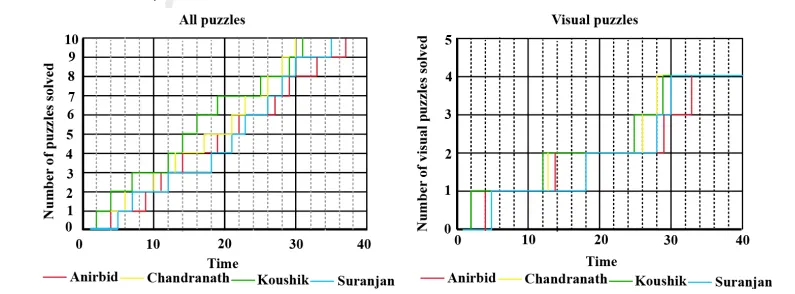
At what number in the sequence was the fourth number-based puzzle?
6
Solution :
The correct answer is 6.
Step-by-Step Analysis:
Let us determine the types of all the 10 puzzles (whether they are visual or number-based) by analyzing the two charts provided:
1. The left chart ("All puzzles") tracks the total number of puzzles solved by each competitor over time.
2. The right chart ("Visual puzzles") tracks only the number of visual puzzles solved by each competitor over time.
By comparing the times at which the total number of solved puzzles increases with the times at which the visual puzzle count increases, we can identify which specific puzzles in the sequence are visual puzzles.
Let us analyze the progress of one competitor, Koushik (represented by the green line):
- Koushik solves Puzzle 1 at minutes (his total solved count goes from 0 to 1). At this exact time ( minutes), his visual puzzles solved count also increases from 0 to 1. This means Puzzle 1 is a visual puzzle.
- Koushik solves Puzzle 4 at minutes (his total solved count goes from 3 to 4). At this exact time ( minutes), his visual puzzles solved count increases from 1 to 2. This means Puzzle 4 is a visual puzzle.
- Koushik solves Puzzle 8 at minutes (his total solved count goes from 7 to 8). At this exact time ( minutes), his visual puzzles solved count increases from 2 to 3. This means Puzzle 8 is a visual puzzle.
- Koushik solves Puzzle 9 at minutes (his total solved count goes from 8 to 9). At this exact time ( minutes), his visual puzzles solved count increases from 3 to 4. This means Puzzle 9 is a visual puzzle.
We can verify this pattern with another competitor, such as Chandranath (yellow line):
- Chandranath's visual puzzles solved count increases:
• From 0 to 1 at minutes, which is when he solves Puzzle 1.
• From 1 to 2 at minutes, which is when he solves Puzzle 4.
• From 2 to 3 at minutes, which is when he solves Puzzle 8.
• From 3 to 4 at minutes, which is when he solves Puzzle 9.
Thus, the visual puzzles in the sequence are Puzzles 1, 4, 8, and 9. All other puzzles in the 10-puzzle sequence are number-based.
Let us map out the entire sequence of puzzles from 1 to 10:
- Puzzle 1: Visual (1st visual)
- Puzzle 2: Number-based (1st number-based)
- Puzzle 3: Number-based (2nd number-based)
- Puzzle 4: Visual (2nd visual)
- Puzzle 5: Number-based (3rd number-based)
- Puzzle 6: Number-based (4th number-based)
- Puzzle 7: Number-based (5th number-based)
- Puzzle 8: Visual (3rd visual)
- Puzzle 9: Visual (4th visual)
- Puzzle 10: Number-based (6th number-based)
From the list above, the fourth number-based puzzle is at position 6 in the sequence.
Completely free for students. Educators & coaching institutes get 2 months free Pro trial to create tests.
Access unlimited practice questions, detailed step-by-step solutions, and exam study materials — completely free for students.
Create and conduct professional online assessments with AI question generation, tab proctoring, and comprehensive batch management.

Practice the complete CLAT 2015 UG Question Paper to improve your preparation for the Common Law Admission Test. This previous year paper covers the key sections of CLAT UG, including English, General Knowledge & Current Affairs, Elementary Mathematics, Legal Aptitude, and Logical Reasoning. Solve CLAT 2015 UG questions to understand the previous year exam pattern, practice important concepts, improve accuracy and speed, and prepare effectively for law entrance examinations.

Prepare for CLAT 2019 UG with the complete question paper and solutions. This paper covers all major sections of the Common Law Admission Test (CLAT) Undergraduate exam, including English Language, Current Affairs & General Knowledge, Legal Reasoning, Logical Reasoning, and Quantitative Techniques.Use the CLAT 2019 UG question paper to practice exam-level questions, understand the question pattern, improve time management, and strengthen your preparation for law entrance examinations.
Copyright © 2026 Combe Labs Private Limited. All Rights Reserved.


