
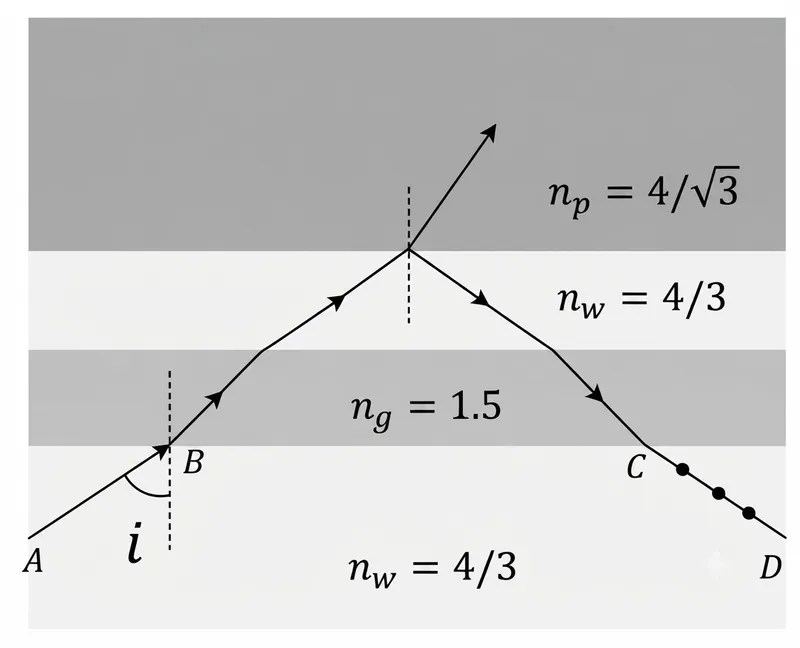
As shown in the figure, a ray AB of unpolarized light enters from water of refractive index into a medium of refractive index after passing through a glass plate of refractive index ng = 1.5 and a layer of water. At a particular incident angle i the reflected ray CD is polarized in the direction as shown in the figure. The value of i (in degrees) is:
Solution :
Correct Answer: 60
Step-by-Step Explanation:
1. Understanding the Physical Setup from the Figure:
From the given diagram, light travels through parallel media layers:
- Bottom layer: Water of refractive index where ray AB is incident at an angle i to the normal.
- Middle layer: Glass plate of refractive index .
- Next layer: Water layer of refractive index .
- Top medium: Medium of refractive index .
2. Polarization by Reflection (Brewster's Law):
The ray reflects from the boundary between the water layer () and the top medium (). The reflected light CD is polarized perpendicular to the plane of incidence (indicated by dots along CD). This means reflection takes place at the Brewster angle (polarizing angle ) at this boundary.
According to Brewster's law, at the polarizing angle for refraction from medium 1 (water) to medium 2 (top medium):
Substituting the given refractive indices:
Therefore, the angle of incidence at the top water-medium boundary is:
3. Applying Snell's Law across Parallel Interfaces:
Since all boundary interfaces are parallel to each other, by Snell's law, the product of the refractive index of a medium and the sine of the angle made by the ray with the normal remains constant across all parallel layers:
Dividing both sides by :
Hence, the value of the incident angle i in degrees is 60.
Completely free for students. Educators & coaching institutes get 2 months free Pro trial to create tests.
Access unlimited practice questions, detailed step-by-step solutions, and exam study materials — completely free for students.
Create and conduct professional online assessments with AI question generation, tab proctoring, and comprehensive batch management.

A comprehensive JEE Advanced 2022 Paper 1 designed to help aspirants understand the examination pattern, difficulty level, and question trends of JEE Advanced. This paper covers important concepts from Physics, Chemistry, and Mathematics, featuring a balanced mix of conceptual, numerical, and advanced application-based questions. It helps students strengthen conceptual understanding, enhance analytical and problem-solving skills, and improve speed and accuracy. Ideal for practice, revision, self-assessment, previous year trend analysis, concept reinforcement, and time management, this paper is a valuable resource for effective JEE Advanced preparation.

A comprehensive JEE Advanced 2022 Paper 2 designed to help aspirants understand the examination pattern, difficulty level, and question trends of JEE Advanced. This paper covers important concepts from Physics, Chemistry, and Mathematics, featuring a balanced mix of conceptual, numerical, and advanced application-based questions. It helps students strengthen conceptual understanding, enhance analytical and problem-solving skills, and improve speed and accuracy. Ideal for practice, revision, self-assessment, previous year trend analysis, concept reinforcement, and time management, this paper is a valuable resource for effective JEE Advanced preparation.
Copyright © 2026 Combe Labs Private Limited. All Rights Reserved.


