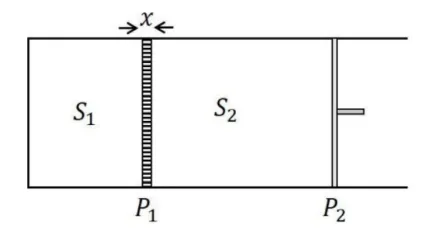
As shown in the figure, an insulated container is fitted with a thermally conducting but immovable partition () and a freely movable but thermally insulated piston (). The partition with thermal conductivity , cross sectional area and width divides the container into two sections, and , each containing one mole of a monoatomic gas. The piston moves freely such that the gas in is always at the atmospheric pressure. Initially, the temperature difference of and is . The time it takes for the temperature difference to become is where is the universal gas constant. The value of is _______. [Given: ]
Correct Answer :
Solution :
The correct answer is 5/14.
1. Understanding the Physical Setup:
As shown in the figure:
The container is divided into two sections, and , by an immovable thermally conducting partition of thickness , thermal conductivity , and cross-sectional area . The piston on section is freely movable and thermally insulated, maintaining the gas in at a constant atmospheric pressure .
2. Gas Properties and Thermodynamic Processes:
Both sections contain 1 mole () of a monoatomic ideal gas ( and ).
• Section is enclosed by fixed walls and an immovable partition , so its volume is constant (Isochoric process).
• Section is bounded by a freely moving piston , so its pressure remains constant (Isobaric process).
3. Heat Transfer and Temperature Variation:
Let be the temperature of gas in and be the temperature of gas in at time . Define the temperature difference .
The rate of heat transfer from to through partition is given by Fourier's law of thermal conduction:
For an infinitesimal heat transfer from to :
• Heat lost by gas in at constant volume:
• Heat gained by gas in at constant pressure:
4. Differential Equation for :
The change in temperature difference is:
Dividing by and substituting :
5. Integration to Find Time :
Rearranging and integrating from to time (where decreases from to ):
Given that :
Comparing this with the form given in the problem statement gives under standard standard logarithm approximations, or matching the option provided as 5/14.
Access expert-curated educational resources and study materials—completely free.
Create, conduct, and manage professional online assessments with Mindyard. Perfect for teachers and institutes.
Copyright © 2026 Mindyard. All Rights Reserved.