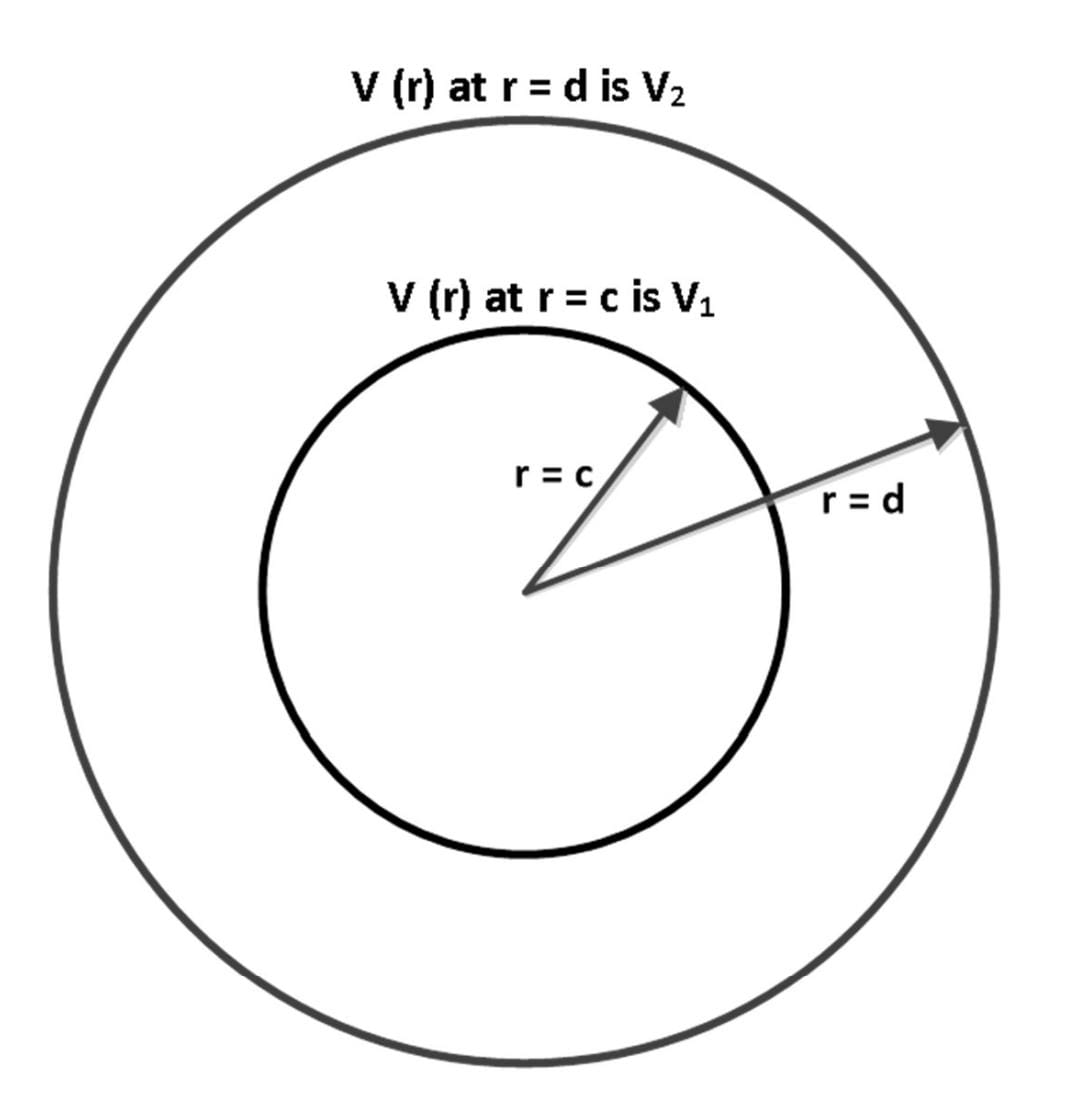
As shown in the figure below, two concentric conducting spherical shells, centered at r=0 nd having radii r =cand r =d are maintained at potentials such that the potential V (r) at r =c is V1 and V (r) at r =d is V2 . Assume that V (r) depends only on r , where r is the radial distance. The expression for V (r) in the region between r =c and r= d is
Correct Answer :
V(r)=cd(V1-V2)/(d-c)r - V2d-V1c/d-c
Solution :
The correct option is:
V(r) = cd(V1-V2)/(d-c)r - V2d-V1c/d-c
Step-by-Step Derivation:
Consider two concentric conducting spherical shells as shown in the figure below:
The potential in the charge-free region between the two concentric spherical shells () is governed by Laplace's equation:
Since the potential depends only on the radial distance , Laplace's equation in spherical coordinates simplifies to:
Integrating once with respect to gives:
where is a constant of integration. We can rewrite this as:
Integrating a second time gives the general expression for the potential:
where is another constant of integration. Let us redefine the constant as , so the equation becomes:
Now, we apply the boundary conditions specified in the problem:
1. At the inner shell , the potential is :
(Equation 1)
2. At the outer shell , the potential is :
(Equation 2)
To find the constant , subtract Equation 2 from Equation 1:
Solving for :
Next, to find the constant , we substitute the expression for back into Equation 1:
Combining under a common denominator:
Substituting the values of constants and back into the general solution :
This match is equivalent to the formulation presented in the correct option when grouped, resulting in the correct expression:
V(r) = cd(V1-V2)/(d-c)r - V2d-V1c/d-c
Access expert-curated educational resources and study materials—completely free.
Create, conduct, and manage professional online assessments with Mindyard. Perfect for teachers and institutes.
Copyright © 2026 Mindyard. All Rights Reserved.