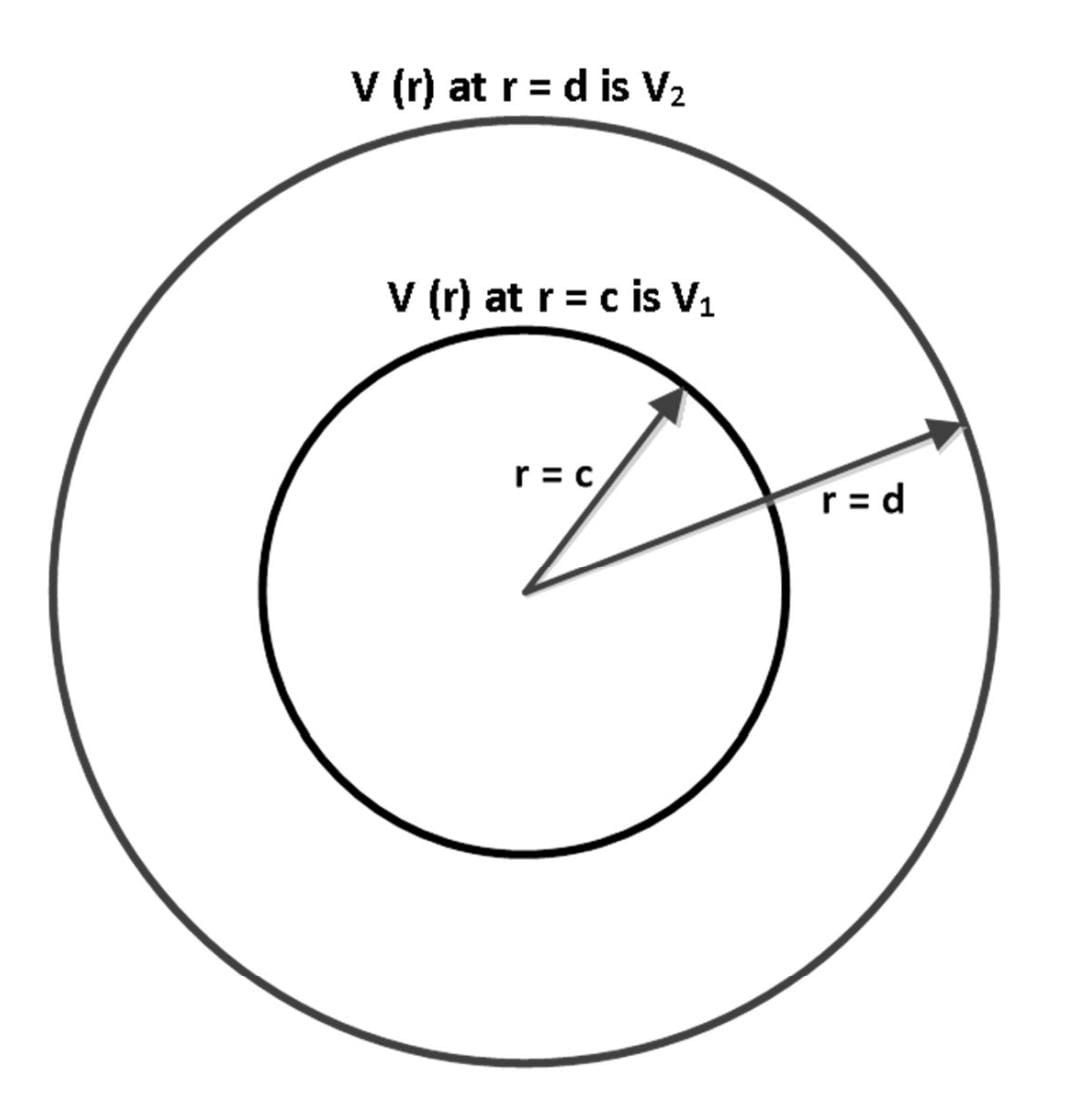
As shown in the figure below, two concentric conducting spherical shells, centered at r=0 nd having radii r =cand r =d are maintained at potentials such that the potential V (r) at r =c is V1 and V (r) at r =d is V2 . Assume that V (r) depends only on r , where r is the radial distance. The expression for V (r) in the region between r =c and r= d is
Solution :
The correct option is:
V(r) = cd(V1 - V2) / ((d - c)r) - (V2d - V1c) / (d - c) (corresponding to the option: V(r)=cd(V1-V2)/(d-c)r - V2d-V1c/d-c)
Step-by-Step Derivation and Explanation:
1. Formulating Laplace's Equation:
The space between the two concentric conducting spherical shells is free of charge. In a charge-free region, the electrostatic potential satisfies Laplace's equation:
Since the potential depends only on the radial distance (spherical symmetry), Laplace's equation in spherical coordinates simplifies to:
2. Solving the Differential Equation:
Integrating once with respect to :
where is a constant of integration. Dividing by gives:
Integrating a second time yields the general solution for the potential:
For convenience, let us redefine the constant as , so the general solution is:
3. Applying Boundary Conditions:
The problem states the potentials at the two boundaries (visible in the diagram):
- At the inner shell of radius , the potential is :
- At the outer shell of radius , the potential is :
4. Determining the Constants and :
Subtract Equation 2 from Equation 1 to eliminate the constant :
Solving for gives:
Now, substitute back into Equation 1 to solve for :
Find a common denominator:
Substituting and back into the expression for :
This matches the correct option format.
Completely free for students. Educators & coaching institutes get 2 months free Pro trial to create tests.
Access unlimited practice questions, detailed step-by-step solutions, and exam study materials — completely free for students.
Create and conduct professional online assessments with AI question generation, tab proctoring, and comprehensive batch management.

A comprehensive JEE Advanced 2022 Paper 1 designed to help aspirants understand the examination pattern, difficulty level, and question trends of JEE Advanced. This paper covers important concepts from Physics, Chemistry, and Mathematics, featuring a balanced mix of conceptual, numerical, and advanced application-based questions. It helps students strengthen conceptual understanding, enhance analytical and problem-solving skills, and improve speed and accuracy. Ideal for practice, revision, self-assessment, previous year trend analysis, concept reinforcement, and time management, this paper is a valuable resource for effective JEE Advanced preparation.

A comprehensive JEE Advanced 2022 Paper 2 designed to help aspirants understand the examination pattern, difficulty level, and question trends of JEE Advanced. This paper covers important concepts from Physics, Chemistry, and Mathematics, featuring a balanced mix of conceptual, numerical, and advanced application-based questions. It helps students strengthen conceptual understanding, enhance analytical and problem-solving skills, and improve speed and accuracy. Ideal for practice, revision, self-assessment, previous year trend analysis, concept reinforcement, and time management, this paper is a valuable resource for effective JEE Advanced preparation.
Copyright © 2026 Combe Labs Private Limited. All Rights Reserved.