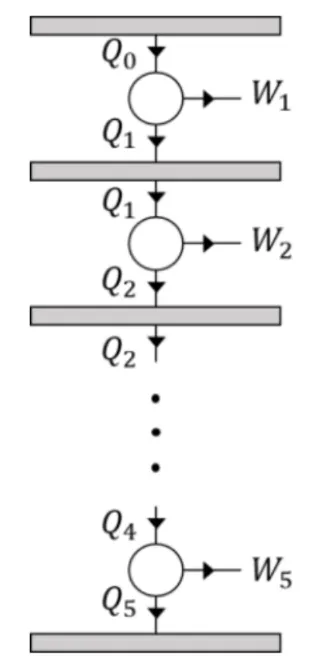
As shown in the figure, five Carnot engines, each with efficiency and same number of cycles per unit time, are operating between six heat reservoirs. The amount of heat released per cycle by one engine is completely absorbed by the next engine. Consider to be the amount of heat absorbed per cycle by the first engine and as the amount of total work done by all the engines per cycle, then the net efficiency of the system is found to be . The value of is _______.
Correct Answer :
Solution :
The correct answer is 1/3.
Step-by-Step Solution:
As depicted in the given diagram, five Carnot engines are arranged in series between six heat reservoirs. The first engine absorbs heat and releases heat , performing work . The second engine absorbs heat and releases heat , performing work , and so on, down to the fifth engine which absorbs heat and releases heat , performing work .
1. Efficiency of an individual Carnot engine:
The efficiency of each engine is defined as the ratio of work done to the heat absorbed, or in terms of heat rejected:
From this, we get:
2. Relation for heat rejected by each stage:
For the 1st engine:
For the 2nd engine:
Continuing this pattern for all five engines, the heat rejected by the final (5th) engine is:
3. Total Work Done ():
By conservation of energy for the entire series of engines, the total work done per cycle is the total heat absorbed from the primary reservoir minus the heat finally rejected to the lowest reservoir:
4. Net Efficiency of the system ():
The net efficiency is given by:
We are given that . Substituting this into the equation:
Rearranging the terms:
Notice that and , so:
Taking the 5th root on both sides:
Thus, the value of is 1/3.
Access expert-curated educational resources and study materials—completely free.
Create, conduct, and manage professional online assessments with Mindyard. Perfect for teachers and institutes.
Copyright © 2026 Mindyard. All Rights Reserved.