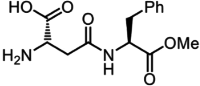
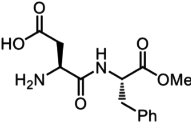
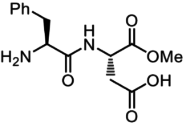
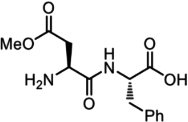
Aspartame, an artificial sweetener, is a dipeptide aspartyl phenylalanine methyl ester. The structure of aspartame is
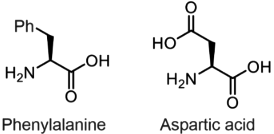
Structures of phenylalanine and aspartic acid are given below.
Correct Answer :
Solution :
The correct option is:
Step-by-Step Explanation:
1. Understanding the Components of Aspartame:
Aspartame is chemically defined as an aspartyl phenylalanine methyl ester. This name tells us three main structural details:
• Aspartyl residue (N-terminus): The dipeptide has L-aspartic acid at the N-terminal end. The α-carboxyl group of aspartic acid forms the peptide link (amide bond) with the amino group of phenylalanine.
• Phenylalanine residue: L-phenylalanine forms the next amino acid unit connected via the peptide linkage.
• Methyl Ester (C-terminus): The C-terminal carboxyl group (-COOH) of phenylalanine is esterified with a methyl group (-OMe).
2. Structural Breakdown:
• Aspartic acid part: H2N-CH(CH2COOH)-C(=O)-
It retains its free N-terminal amino group (-NH2) and its side-chain carboxylic acid group (-CH2COOH).
• Peptide Linkage: -C(=O)-NH-
Formed between the α-carboxylic acid group of aspartic acid and the α-amino group of phenylalanine.
• Phenylalanine Methyl Ester part: -NH-CH(CH2Ph)-C(=O)OMe
The α-carboxyl group of phenylalanine is converted into a methyl ester group (-COOMe).
3. Comparing with the Given Options:
Looking at the provided structures of phenylalanine and aspartic acid:
• Option 2 matches the correct stereochemistry and structural connectivity where aspartic acid is on the left with a free -NH2 group and a free side-chain carboxyl group (-COOH), linked through an amide bond (-CO-NH-) to phenylalanine whose terminal carboxylic group is esterified as -COOMe:
Access expert-curated educational resources and study materials—completely free.
Create, conduct, and manage professional online assessments with Mindyard. Perfect for teachers and institutes.
Copyright © 2026 Mindyard. All Rights Reserved.