Atruss is composed of members AB, BC, CD, AD and BD, as shown in the figure. A vertical load of 10 kN is applied at point D. The magnitude of force (in kN) in the member BC is _______.
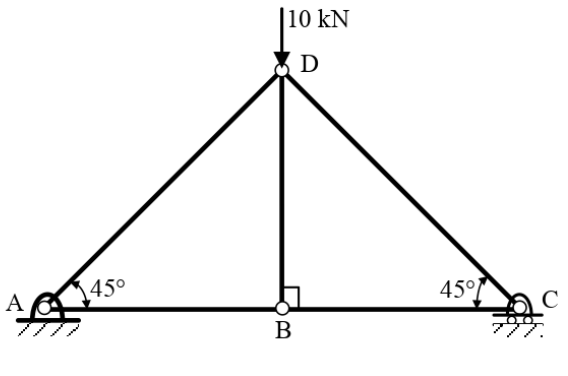
Correct Answer :
Solution :
Correct Answer: The magnitude of force in member BC is 5 kN.
To find the force in the member BC, we can analyze the support reactions and then use the method of joints at joint C.
Step 1: Calculate the support reactions
The truss is symmetrical with respect to the vertical line passing through member BD. A vertical downward load of 10 kN is applied at node D.
Let be the vertical reaction at support A and be the vertical reaction at support C.
By symmetry, the vertical reactions at the two supports are equal:
Thus, the upward vertical reaction at support C is .
Step 2: Analyze Joint C
Let us consider the equilibrium of joint C. At joint C, the forces acting are:
1. The vertical support reaction acting upwards.
2. The force in member CD, denoted as , acting at an angle of 45° to the horizontal.
3. The force in member BC, denoted as , acting horizontally along the member BC.
Using the equations of equilibrium for joint C:
Sum of vertical forces:
(Compression)
Sum of horizontal forces:
Assuming tensile forces are positive (acting away from the joint):
Substitute the value of into the equation:
(Tension)
Therefore, the magnitude of the force in member BC is 5 kN.
Access expert-curated educational resources and study materials—completely free.
Create, conduct, and manage professional online assessments with Mindyard. Perfect for teachers and institutes.
Copyright © 2026 Mindyard. All Rights Reserved.