
Below are given two sets – Set-I and Set-II.
Match the two sets and indicate your answer
by selecting the correct code:
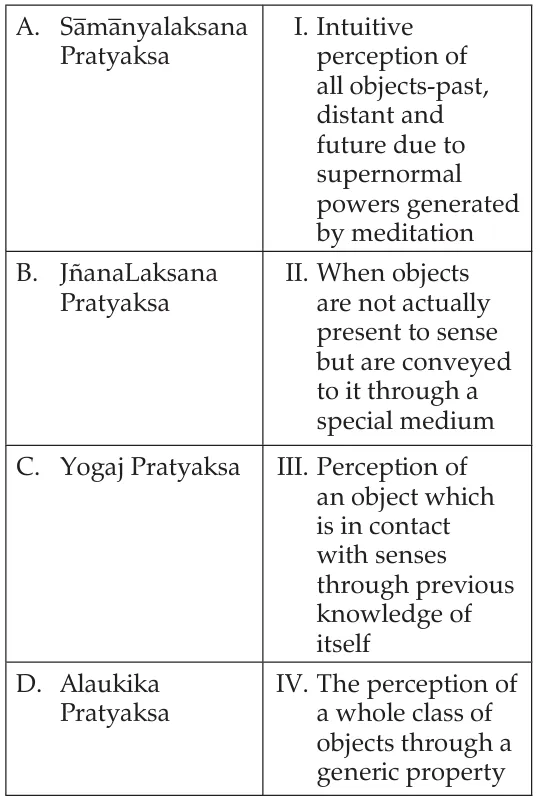
Choose the correct code from the options given below.
Correct Answer :
A - IV, B - III, C - I, D - II
Solution :
The correct option is A - IV, B - III, C - I, D - II.
In Indian Philosophy (specifically the Nyāya school), Pratyakṣa (Perception) is classified into two main categories:
1. Laukika (Ordinary): Occurs when there is direct contact between the sense organs and the object.
2. Alaukika (Extraordinary): Occurs when the object is not directly presented to the senses in the normal way but is perceived through an extraordinary medium or relationship.
Let us analyze the terms shown in the image from Set-I and match them with their respective descriptions in Set-II:
1. Sāmānyalaksana Pratyakṣa (A) matches with IV:
Sāmānyalaksana is the perception of a universal (sāmānya) or generic feature. Through this type of perception, when we perceive an individual object (like a particular cow), we simultaneously perceive the universal class-essence or generic property (like "cowness") that is shared by all members of that class. Hence, it represents "The perception of a whole class of objects through a generic property" (IV).
2. Jñānalaksana Pratyakṣa (B) matches with III:
Jñānalaksana is the extraordinary perception of an object where past knowledge of it acts as the medium of sensory contact. For instance, when we see a piece of sandalwood from a distance and immediately perceive it as "fragrant sandalwood", the visual sense organ does not directly contact the scent, but the past knowledge of the scent is revived and leads to the perception. Hence, it represents "Perception of an object which is in contact with senses through previous knowledge of itself" (III).
3. Yogaj Pratyakṣa (C) matches with I:
Yogaj is the intuitive perception possessed by yogis. Through intense meditation (yoga) and spiritual discipline, yogis develop extraordinary powers that enable them to perceive all objects—whether they belong to the past, are located far away (distant), or lie in the future. Hence, it represents "Intuitive perception of all objects-past, distant and future due to supernormal powers generated by meditation" (I).
4. Alaukika Pratyakṣa (D) matches with II:
Alaukika Pratyakṣa is the overarching category of extraordinary perception itself. It operates in instances where objects are not physically present to the senses in a normal manner but are instead brought to awareness through an extraordinary medium or connection. Hence, it represents "When objects are not actually present to sense but are conveyed to it through a special medium" (II).
By mapping these descriptions together, we get the correct combination:
A - IV, B - III, C - I, D - II
Access expert-curated educational resources and study materials—completely free.
Create, conduct, and manage professional online assessments with Mindyard. Perfect for teachers and institutes.
Copyright © 2026 Mindyard. All Rights Reserved.




