Black dot shown in the figure qualitatively represents the shear centre of the angle section. The option which represents the position of the shear centre is:
Options
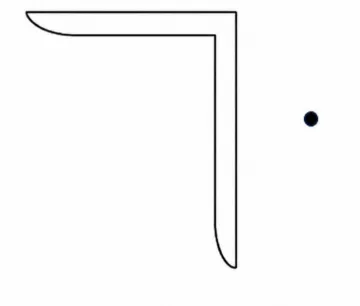
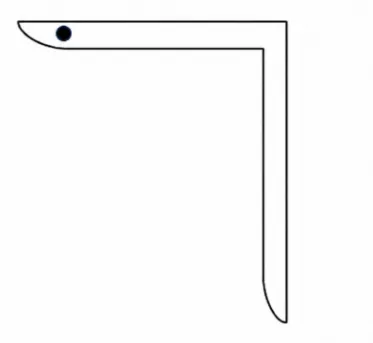
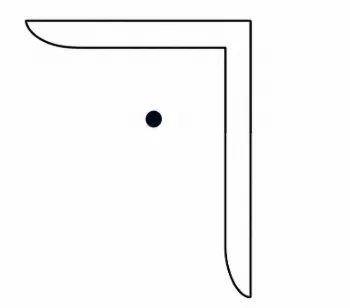
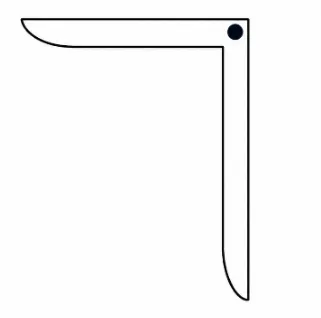
Correct Answer :
Solution :
The correct option is the fourth option (represented by the image where the black dot is located at the corner vertex representing the intersection of the centerlines of the two legs).
Step-by-Step Explanation:
1. Understanding the Shear Centre
The shear centre (or centre of twist) of a beam's cross-section is the point through which a transverse shear load must be applied so that the member undergoes pure bending without any twisting (torsion). If the line of action of the applied force does not pass through the shear centre, it creates a twisting moment, causing the beam to twist as it bends.
2. Shear Flow in thin-walled Open Sections
For thin-walled open sections, such as an angle section (L-section) consisting of two thin rectangular legs, the shear stresses (and hence the internal shear forces) flow along the centerlines of the respective legs.
Let the shear force in the horizontal leg be:
And the shear force in the vertical leg be:
Because the legs are thin rectangular components, their internal shear force resultants and act directly along the centerlines of these two legs.
3. Locating the Shear Centre of an Angle Section
The lines of action of the two forces and must intersect at the corner junction where the centerlines of the two legs meet. Let us calculate the net moment of these internal forces about this intersection point:
Since the moment of the internal shear forces about the intersection point of the centerlines is zero, this intersection point is the unique point where an external shear load can be applied without producing any twisting moment. Therefore, the shear centre of an angle section lies exactly at the intersection of the centerlines of its two legs.
4. Analysis of the Options:
By analyzing the provided images representing each option:
- Option 1 (first image): The black dot is positioned outside the section to the right of the vertical leg.
- Option 2 (second image): The black dot is located along the horizontal leg, far to the left of the intersection corner.
- Option 3 (third image): The black dot is situated inside the corner region (near the centroid of the section).
- Option 4 (fourth image): The black dot is located exactly at the intersection of the centerlines of the horizontal and vertical legs of the angle section.
Thus, the fourth option correctly represents the position of the shear centre.
Access expert-curated educational resources and study materials—completely free.
Create, conduct, and manage professional online assessments with Mindyard. Perfect for teachers and institutes.
Copyright © 2026 Mindyard. All Rights Reserved.