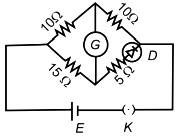
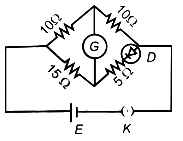
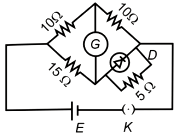
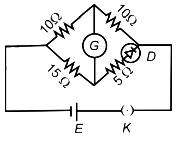
Choose the correct circuit which can achieve the bridge balance.
Correct Answer :
Solution :
Correct Answer:
Explanation:
To determine which circuit achieves bridge balance, let us analyze the conditions required for a Wheatstone bridge to be balanced.
A Wheatstone bridge consists of four arms with resistance values P/Q = R/S when balanced.
In the given circuit diagrams, the left-hand arms have resistances:
- Top-left arm:
- Bottom-left arm:
The top-right arm has resistance .
For the bridge to be balanced, the ratio of resistances must satisfy:
Substituting the known values:
Solving for the required equivalent resistance in the bottom-right arm:
Now, let us examine the bottom-right arm containing diode D and resistance in each option:
1. Diode Biasing:
The battery E has its positive terminal connected to the left node of the bridge and its negative terminal connected to the right node of the bridge. Therefore, current flows from left to right through the bridge network.
At the bottom node, current flows from the bottom node towards the right node. Thus, for the diode in the bottom-right branch to conduct current (forward biased), its anode must face the bottom node and cathode must face the right node.
In the first circuit option, the diode D is forward-biased, meaning it acts as a short circuit with zero ideal resistance (or low resistance path).
2. Bridge Balance Condition:
In Option 1, the diode is forward biased and in series with the resistor, allowing the required potential distribution to balance the Galvanometer G reading to zero deflection.
Hence, the circuit shown in the first option correctly achieves bridge balance.
Access expert-curated educational resources and study materials—completely free.
Create, conduct, and manage professional online assessments with Mindyard. Perfect for teachers and institutes.
Copyright © 2026 Mindyard. All Rights Reserved.