
Choose the correct circuit which can achieve the bridge balance
Options
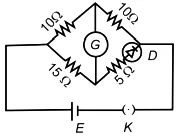 .
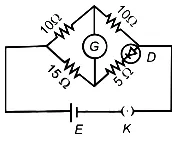 .
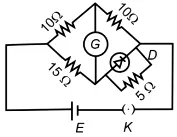 .
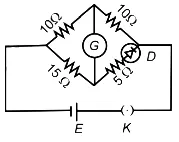 .
.Solution :
To find the correct circuit that can achieve the bridge balance, we must analyze the balance condition of a Wheatstone bridge.
A Wheatstone bridge is balanced when the ratio of the resistances of the adjacent arms is equal. For a standard bridge configuration with resistors:
- Top-left arm:
- Top-right arm:
- Bottom-left arm:
- Bottom-right arm: (consisting of a resistor in series with a diode )
The balance condition is given by:
Substituting the given resistance values:
Since the bottom-right arm contains a resistor in series with a diode , the total resistance of this arm is:
where is the dynamic resistance of the diode. For the arm resistance to be :
For the diode to have a finite, positive dynamic resistance (), it must be in the forward-biased state. If it were reverse-biased, its resistance would be ideally infinite, and the bridge could not be balanced.
Looking at the battery connection, the positive terminal is connected to the left junction and the negative terminal is connected to the right junction. Thus, current flows from the left junction towards the right junction.
In the bottom branch, current flows from the bottom junction to the right junction. For the diode to be forward-biased under this current flow, its anode (the triangle side of the symbol) must be connected to the bottom junction, and its cathode (the bar side of the symbol) must be connected to the right junction. Therefore, the arrow of the diode must point towards the right junction.
Completely free for students. Educators & coaching institutes get 2 months free Pro trial to create tests.
Access unlimited practice questions, detailed step-by-step solutions, and exam study materials — completely free for students.
Create and conduct professional online assessments with AI question generation, tab proctoring, and comprehensive batch management.

A comprehensive JEE Advanced 2022 Paper 1 designed to help aspirants understand the examination pattern, difficulty level, and question trends of JEE Advanced. This paper covers important concepts from Physics, Chemistry, and Mathematics, featuring a balanced mix of conceptual, numerical, and advanced application-based questions. It helps students strengthen conceptual understanding, enhance analytical and problem-solving skills, and improve speed and accuracy. Ideal for practice, revision, self-assessment, previous year trend analysis, concept reinforcement, and time management, this paper is a valuable resource for effective JEE Advanced preparation.

A comprehensive JEE Advanced 2022 Paper 2 designed to help aspirants understand the examination pattern, difficulty level, and question trends of JEE Advanced. This paper covers important concepts from Physics, Chemistry, and Mathematics, featuring a balanced mix of conceptual, numerical, and advanced application-based questions. It helps students strengthen conceptual understanding, enhance analytical and problem-solving skills, and improve speed and accuracy. Ideal for practice, revision, self-assessment, previous year trend analysis, concept reinforcement, and time management, this paper is a valuable resource for effective JEE Advanced preparation.
Copyright © 2026 Combe Labs Private Limited. All Rights Reserved.


