
Comprehension:
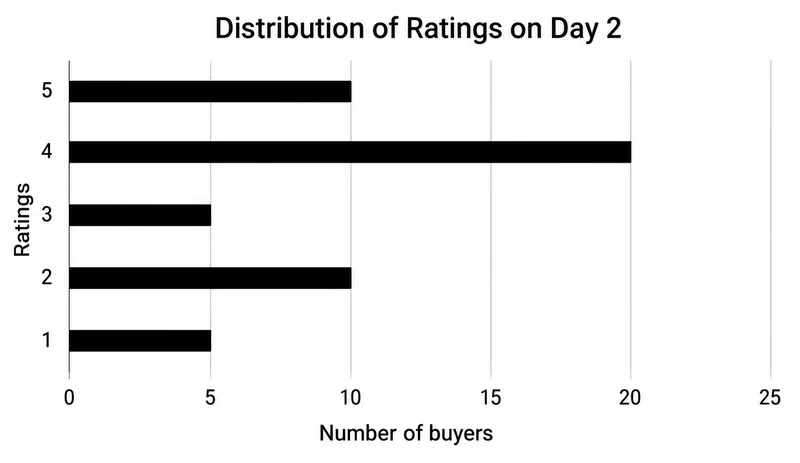
An online e-commerce firm receives daily integer product ratings from 1 through 5 given by buyers. The daily average is the average of the ratings given on that day. The cumu lative average is the average of all ratings given on or before that day. The rating system began on Day 1, and the cumulative averages were 3 and 3.1 at the end of Day 1 and Day 2, respectively. The distribution of ratings on Day 2 is given in the figure below
The following information is known about ratings on Day 3.
1. 100 buyers gave product ratings on Day 3.
2. The modes of the product ratings were 4 and 5.
3. The numbers of buyers giving each product rating are non-zero multiples of 10.
4. The same number of buyers gave product ratings of 1 and 2, and that number is half the number of buyers who gave a rating of 3.
Which of the following is true about the cumulative average ratings of Day 2 and Day 3?
Correct Answer :
The cumulative average of Day 3 increased by a percentage between 5% and 8% from Day 2
Solution :
Correct Answer: The cumulative average of Day 3 increased by a percentage between 5% and 8% from Day 2
Step-by-step Explanation:
Step 1: Extract and Analyze the Day 2 Data
By analyzing the bar chart in the provided image titled "Distribution of Ratings on Day 2", we can extract the number of buyers who gave each product rating (from 1 through 5) on Day 2:
• Rating 5: 10 buyers
• Rating 4: 20 buyers
• Rating 3: 5 buyers
• Rating 2: 10 buyers
• Rating 1: 5 buyers
From these values, we calculate the total number of ratings (buyers) on Day 2 () and the sum of these ratings ():
Step 2: Determine Day 1 Ratings
Let be the total number of ratings given on Day 1, and be the sum of those ratings.
We are given that:
• The cumulative average at the end of Day 1 is 3.
• The cumulative average at the end of Day 2 is 3.1.
Using the definition of average, we write:
At the end of Day 2, the cumulative average is:
Substituting the values of , , and into the equation:
Thus, .
At the end of Day 2:
• Total number of ratings:
• Sum of all ratings:
Step 3: Analyze the Day 3 Ratings
Let represent the number of buyers giving ratings 1, 2, 3, 4, and 5 respectively on Day 3.
We are given the following conditions for Day 3:
1. Total number of buyers on Day 3 is 100:
2. The counts are non-zero multiples of 10, meaning .
3. The same number of buyers gave ratings of 1 and 2, which is half the number of buyers who gave a rating of 3:
4. The modes of the ratings are 4 and 5. This means , and this count must be strictly greater than any other individual count (i.e., , , and ).
Let us express where is a positive integer.
Then:
•
•
Let's test possible values for :
• If :
, , .
The sum of these counts is buyers.
The remaining buyers are .
Since 4 and 5 are the joint modes, .
Here, the modal count is 30, which is strictly greater than the next highest count (). This configuration is valid.
• If :
, , .
The sum of these counts would be at least buyers.
This leaves at most buyers for , which gives .
In this case, 4 and 5 cannot be the modes because their counts would be less than (which is at least 40). Hence, is the only possible scenario.
Therefore, the unique distribution of ratings on Day 3 is:
• , , , ,
Now, let's calculate the sum of ratings received on Day 3 ():
Step 4: Calculate Cumulative Average at the end of Day 3
• Total cumulative number of ratings at the end of Day 3:
• Total cumulative sum of ratings at the end of Day 3:
• Cumulative average at the end of Day 3:
Step 5: Calculate the Percentage Increase
We now compute the percentage change from the Day 2 cumulative average () to the Day 3 cumulative average ():
Since is strictly between and , the correct statement is: "The cumulative average of Day 3 increased by a percentage between 5% and 8% from Day 2."
Access expert-curated educational resources and study materials—completely free.
Create, conduct, and manage professional online assessments with Mindyard. Perfect for teachers and institutes.
Copyright © 2026 Mindyard. All Rights Reserved.