
Comprehension Passage:
The air-conditioner (AC) in a large room can be operated either in REGULAR mode or in POWERmodetoreduce the temperature.
If the AC operates in REGULAR mode, then it brings down the temperature inside the room (called inside temperature) at a constant rate to the set temperature in 1 hour. If it operates in POWERmode, then this is achieved in 30 minutes.
If the AC is switched off, then the inside temperature rises at a constant rate so as to reach the temperature outside at the time of switching off in 1 hour.
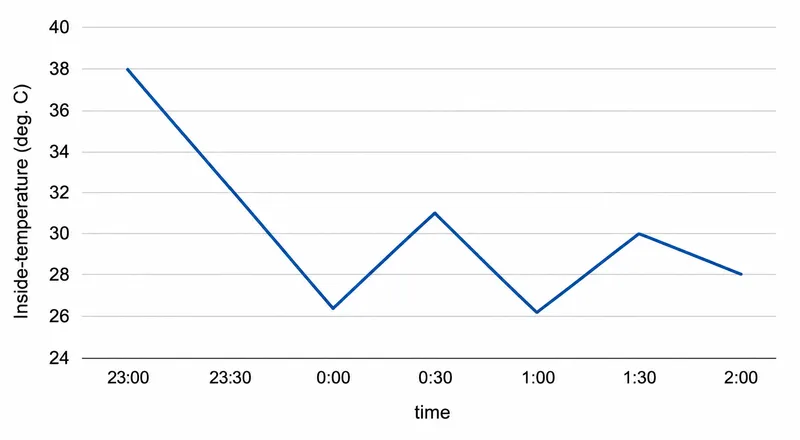
The temperature outside has been falling at a constant rate from 7 pm onward until 3 am on a particular night. The following graph shows the inside temperature between 11 pm (23:00) and 2 am (2:00) that night.
The following facts are known about the AC operation that night:
• The ACwas turned on for the first time that night at 11 pm (23:00).
• The AC setting was changed (including turning it on/off, and/or setting different temperatures) only at the beginning of the hour or at 30 minutes after the hour.
• The ACwasusedinPOWERmodeforlongerduration than in REGULARmodeduring this 3-hour period.
What best can be concluded about the number of times the AC must have either been turned on or the AC temperature setting been altered between 11:01 pm and 1:59 am?
Correct Answer :
Exactly 3
Solution :
The correct option is Exactly 3.
To determine the number of times the air-conditioner (AC) was either turned on or had its temperature setting altered between 11:01 pm and 1:59 am, let's analyze the behavior of the inside temperature in each 30-minute interval.
1. Analysis of Heating and Cooling Intervals:
Based on the graph, the inside temperature changes as follows:
• 23:00 to 0:00: Temperature decreases from 38°C to 26.4°C (Cooling)
• 0:00 to 0:30: Temperature rises from 26.4°C to 31°C (Heating - AC is OFF)
• 0:30 to 1:00: Temperature decreases from 31°C to 26.2°C (Cooling)
• 1:00 to 1:30: Temperature rises from 26.2°C to 30°C (Heating - AC is OFF)
• 1:30 to 2:00: Temperature decreases from 30°C to 28°C (Cooling)
Since the temperature rises during the intervals 0:00–0:30 and 1:00–1:30, the AC must have been turned OFF at 0:00 (12:00 am) and 1:00 am.
2. Identifying the Mode of Operation (POWER vs. REGULAR):
The total duration of the 3-hour period is 180 minutes.
The AC is OFF for two 30-minute intervals (0:00 to 0:30 and 1:00 to 1:30), which is a total of 1 hour (60 minutes).
Thus, the AC is ON for a total of:
We are given that the AC was operated in POWER mode for a longer duration than in REGULAR mode. Since changes can only occur at 30-minute intervals:
Let us analyze the first cooling segment (23:00 to 0:00). It is a continuous 1-hour cooling period showing a constant rate of temperature drop.
• If it were operated entirely in REGULAR mode, the REGULAR mode duration would be 1 hour, meaning the POWER mode duration could be at most 1 hour. This violates the condition that POWER mode was used longer than REGULAR mode.
• Therefore, the segment from 23:00 to 0:00 must have been operated in POWER mode.
Since a single session of POWER mode cooling takes exactly 30 minutes to reach its set temperature, the 1-hour interval from 23:00 to 0:00 must consist of two consecutive 30-minute POWER mode settings:
1. From 23:00 to 23:30, cooled to 32.2°C.
2. From 23:30 to 0:00, cooled to 26.4°C.
This means the temperature setting was altered at 23:30.
3. Counting the Events Between 11:01 pm and 1:59 am:
We need to count only the instances where the AC was either turned ON or the temperature setting was altered strictly within the time interval (11:01 pm, 1:59 am):
• At 23:30 (11:30 pm): The temperature setting was altered (Change 1).
• At 0:00 (12:00 am): The AC was turned OFF (Not counted, as it is a turn-off event).
• At 0:30 (12:30 am): The AC was turned ON (Change 2).
• At 1:00 (1:00 am): The AC was turned OFF (Not counted, as it is a turn-off event).
• At 1:30 (1:30 am): The AC was turned ON (Change 3).
Summing these up, there are exactly 3 such events in this time period.
Access expert-curated educational resources and study materials—completely free.
Create, conduct, and manage professional online assessments with Mindyard. Perfect for teachers and institutes.
Copyright © 2026 Mindyard. All Rights Reserved.




