Comprehension Passage:
The air-conditioner (AC) in a large room can be operated either in REGULAR mode or in POWERmodetoreduce the temperature.
If the AC operates in REGULAR mode, then it brings down the temperature inside the room (called inside temperature) at a constant rate to the set temperature in 1 hour. If it operates in POWERmode, then this is achieved in 30 minutes.
If the AC is switched off, then the inside temperature rises at a constant rate so as to reach the temperature outside at the time of switching off in 1 hour.
The temperature outside has been falling at a constant rate from 7 pm onward until 3 am on a particular night. The following graph shows the inside temperature between 11 pm (23:00) and 2 am (2:00) that night.
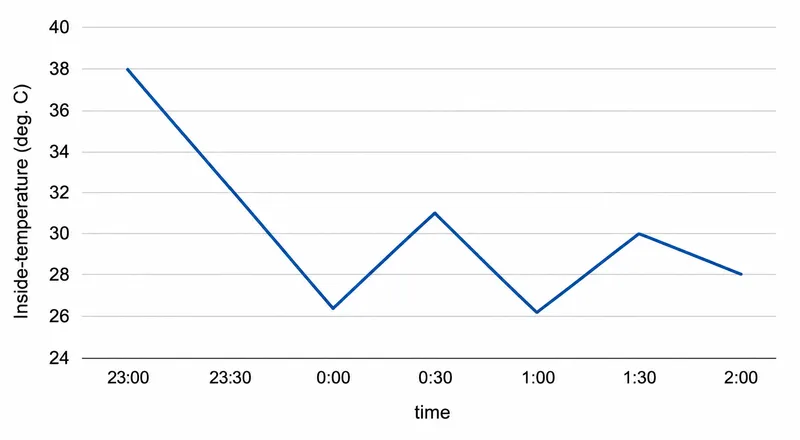
The following facts are known about the AC operation that night:
• The ACwas turned on for the first time that night at 11 pm (23:00).
• The AC setting was changed (including turning it on/off, and/or setting different temperatures) only at the beginning of the hour or at 30 minutes after the hour.
• The ACwasusedinPOWERmodeforlongerduration than in REGULARmodeduring this 3-hour period.
What was the temperature outside, in degree Celsius, at 1 am?
Correct Answer :
34
Solution :
Correct Answer: The temperature outside at 1 am was 34°C.
To find the outside temperature at 1 am, we analyze the cooling and warming cycles of the air conditioner (AC) using the rules provided and the data from the graph:
1. Analyze the Warming (AC OFF) Intervals:
When the AC is switched off, the inside temperature rises at a constant rate to reach the outside temperature at the time of switching off in 1 hour.
Let be the inside temperature and be the outside temperature at time .
• First Warming Interval (0:00 to 0:30):
From the graph, the inside temperature rises from to in 30 minutes (0.5 hours).
Using the linear heating formula when the AC is OFF:
Substituting :
Multiplying both sides by 2:
— (Equation 1)
• Second Warming Interval (1:00 to 1:30):
From the graph, the inside temperature rises from to in 30 minutes (0.5 hours).
Using the linear heating formula:
Substituting :
Multiplying both sides by 2:
— (Equation 2)
2. Incorporating the AC Mode Constraint:
We are given that the AC was used in POWER mode for a longer duration than in REGULAR mode during this 3-hour period.
Looking at the cooling cycles:
• From 23:00 to 0:00, the temperature decreases along a single straight line. If it were operated in REGULAR mode, it would be 1 hour of REGULAR mode.
• Since the total duration is 3 hours, with 1 hour of total OFF time (0:00 to 0:30 and 1:00 to 1:30), the total ON time is 2 hours.
• For the POWER mode duration to be strictly greater than the REGULAR mode duration, the total REGULAR mode duration must be less than 1 hour. This means the cooling during the first hour (23:00 to 0:00) must contain POWER mode.
• Specifically, if 23:00 to 23:30 is REGULAR mode and 23:30 to 0:00 is POWER mode, or vice versa, the total POWER mode duration is 1.0 hour and REGULAR mode duration is 1.0 hour, which would make them equal. Thus, to satisfy the constraint of POWER mode being strictly longer, the cooling from 0:30 to 1:00 and from 1:30 to 2:00 must both be in POWER mode (each 30 minutes, totaling 1 hour).
• In POWER mode, the AC brings down the temperature to the set temperature in exactly 30 minutes. Therefore, the temperature reached at the end of the POWER mode interval is exactly the set temperature.
• For the interval 0:30 to 1:00, the AC is in POWER mode, meaning it reaches the set temperature at 1:00. This set temperature must be an integer or a half-integer value. Looking at the graph, the minimum at 1:00 is exactly .
3. Calculate the Outside Temperature at 1 am:
Substituting into Equation 2:
Thus, the temperature outside at 1 am was 34°C.
Access expert-curated educational resources and study materials—completely free.
Create, conduct, and manage professional online assessments with Mindyard. Perfect for teachers and institutes.
Copyright © 2026 Mindyard. All Rights Reserved.