Comprehension Passage:
The air-conditioner (AC) in a large room can be operated either in REGULAR mode or in POWERmodetoreduce the temperature.
If the AC operates in REGULAR mode, then it brings down the temperature inside the room (called inside temperature) at a constant rate to the set temperature in 1 hour. If it operates in POWERmode, then this is achieved in 30 minutes.
If the AC is switched off, then the inside temperature rises at a constant rate so as to reach the temperature outside at the time of switching off in 1 hour.
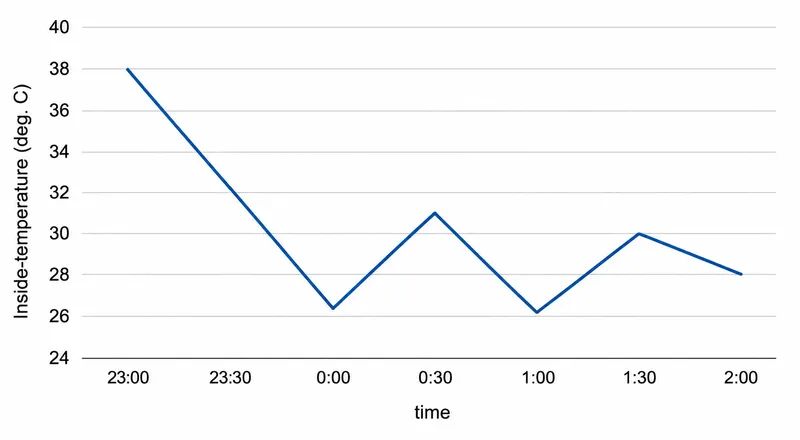
The temperature outside has been falling at a constant rate from 7 pm onward until 3 am on a particular night. The following graph shows the inside temperature between 11 pm (23:00) and 2 am (2:00) that night.
The following facts are known about the AC operation that night:
• The ACwas turned on for the first time that night at 11 pm (23:00).
• The AC setting was changed (including turning it on/off, and/or setting different temperatures) only at the beginning of the hour or at 30 minutes after the hour.
• The ACwasusedinPOWERmodeforlongerduration than in REGULARmodeduring this 3-hour period.
What was the temperature outside, in degree Celsius, at 9 pm?
Solution :
The correct option is 42 (Option 3).
Step-by-step Explanation:
Let us denote the inside temperature at any time t as and the outside temperature as .
According to the problem statement:
1. Outside temperature falls at a constant rate R (in °C/hour) from 7:00 pm onwards.
2. When the AC is switched off, the inside temperature rises at a constant rate such that it would reach the outside temperature at the time of switching off in 1 hour.
Therefore, if the AC is turned off at time
,
the rate of increase in inside temperature is:
After a duration of 30 minutes (0.5 hours), the temperature rise
will be:
1. Analyzing the Graph during the OFF periods:
Looking at the provided graph, we observe two periods where the inside temperature rises:
• From 0:00 to 0:30: The temperature rises from 26°C to 31°C.
• From 1:00 to 1:30: The temperature rises from 26°C to 30°C.
Applying the temperature rise formula for the first interval (0:00 to 0:30), where
:
Applying the temperature rise formula for the second interval (1:00 to 1:30), where
:
2. Finding the rate of fall of the outside temperature (R):
Since the outside temperature falls at a constant rate R:
3. Determining the outside temperature at 9:00 pm:
We need to find the outside temperature at 9:00 pm (21:00), which is 3 hours before 0:00 am (24:00).
Since the temperature increases as we go backward in time at the rate of 2°C/hour:
Thus, the temperature outside at 9:00 pm was 42°C.
Completely free for students. Educators & coaching institutes get 2 months free Pro trial to create tests.
Access unlimited practice questions, detailed step-by-step solutions, and exam study materials — completely free for students.
Create and conduct professional online assessments with AI question generation, tab proctoring, and comprehensive batch management.

Prepare effectively for CAT 2017 Slot 1 with this complete question paper and detailed solutions. This paper includes all sections—Verbal Ability & Reading Comprehension (VARC), Data Interpretation & Logical Reasoning (DILR), and Quantitative Aptitude (QA)—with step-by-step explanations to help you understand concepts, improve problem-solving speed, and strengthen your exam strategy. Practicing the CAT 2017 Slot 1 paper is an excellent way to experience the actual exam pattern, difficulty level, and question types asked in the Common Admission Test. This resource is ideal for MBA aspirants targeting top IIMs and other leading B-schools.

Prepare for CAT 2017 Slot 2 with the complete question paper and detailed solutions. This paper covers all three sections—Verbal Ability & Reading Comprehension (VARC), Data Interpretation & Logical Reasoning (DILR), and Quantitative Aptitude (QA)—with clear, step-by-step explanations to help you master important concepts and improve your problem-solving speed. Solving the CAT 2017 Slot 2 paper gives you valuable insight into the actual exam pattern, question types, and difficulty level of the Common Admission Test. It is an essential practice resource for MBA aspirants aiming for admission to IIMs and other top B-schools.
Copyright © 2026 Combe Labs Private Limited. All Rights Reserved.