
Question Details

Comprehension Passage:

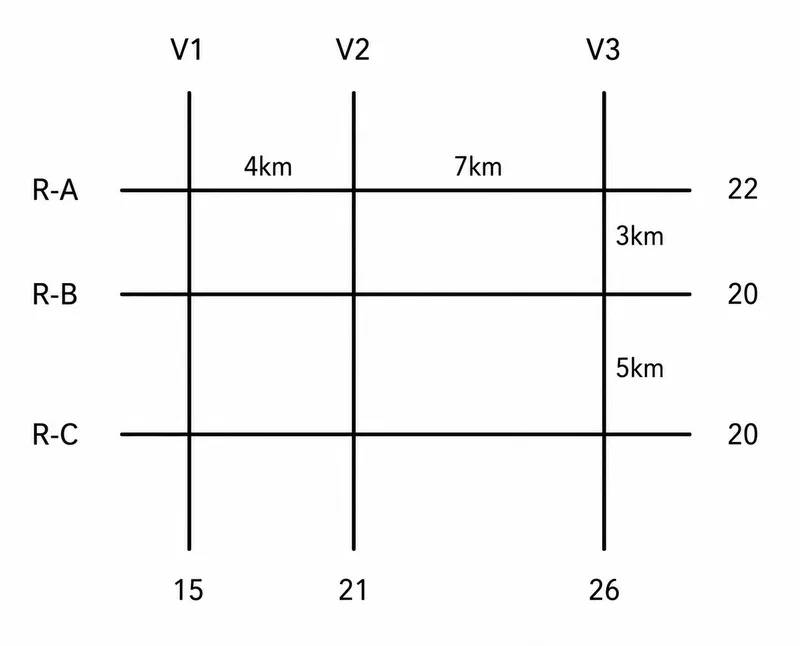
The figure below shows a network with three parallel roads represented by horizontal lines R-A, R-B, and R-C and another three parallel roads represented by vertical lines V1, V2, and V3. The figure also shows the distance (in km) between two adjacent intersections. Six ATMs are placed at six of the nine road intersections.


Each ATM has a distinct integer cash requirement (in Rs. Lakhs), and the numbers at the end of each line in the figure indicate the total cash requirements of all ATMs placed on the corresponding road. For example, the total cash requirement of the ATM(s) placed on road R-A is Rs. 22 Lakhs.


The following additional information is known:


1. The ATMs with the minimum and maximum cash requirements of Rs. 7 Lakhs and Rs. 15 Lakhs are placed on the same road.


2. The road distance between the ATM with the second highest cash requirement and the ATM located at the intersection of R-C and V3 is 12 km.

What is the number of ATMs whose locations and cash requirements can both be uniquely determined?

Options

A

3

B

4

C

5

D

8

Show Answer

Correct Answer :

Option A

3

Solution :

The correct answer is 3.

Let us analyze the given network grid, constraints, and distances step-by-step to find the unique locations and values of the ATMs.

Step 1: Identify Intersection Coordinates and Distances
Let the horizontal roads be R-A, R-B, and R-C, and the vertical roads be V1, V2, and V3. The intersections are represented as pairs (Row, Column). From the image, the distances between adjacent lines are:

  • Horizontal distance between V1 and V2 = 4 km, and between V2 and V3 = 7 km.
  • Vertical distance between R-A and R-B = 3 km, and between R-B and R-C = 5 km.

Step 2: Locate the Second Highest ATM using the 12 km Distance Constraint
We are given that the road distance between the ATM with the second highest cash requirement and the ATM at the intersection of R-C and V3 is exactly 12 km. Let us compute the Manhattan distances from (R-C, V3) to all other intersections:

  • Distance to (R-C, V2) = 7 km
  • Distance to (R-C, V1) = 7 + 4 = 11 km
  • Distance to (R-B, V3) = 5 km
  • Distance to (R-B, V2) = 5 + 7 = 12 km
  • Distance to (R-B, V1) = 5 + 7 + 4 = 16 km
  • Distance to (R-A, V3) = 5 + 3 = 8 km
  • Distance to (R-A, V2) = 5 + 3 + 7 = 15 km
  • Distance to (R-A, V1) = 5 + 3 + 7 + 4 = 19 km
The only intersection located exactly 12 km away from (R-C, V3) is (R-B, V2). Therefore:
  • There is an ATM at (R-C, V3).
  • The ATM with the second highest cash requirement is located at (R-B, V2). Let this requirement be x5.

Step 3: Analyze the Minimum (7) and Maximum (15) Cash Requirements
We are given that the minimum and maximum cash requirements are 7 Lakhs and 15 Lakhs, and they are located on the same road. Since they are on the same road, the sum of requirements on that road must be at least 7 + 15 = 22 Lakhs. Looking at the road totals in the image:

  • Row R-A total = 22
  • Row R-B total = 20
  • Row R-C total = 20
  • Column V1 total = 15 (cannot contain both 7 and 15 since 7 + 15 = 22 > 15)
  • Column V2 total = 21 (cannot contain both 7 and 15 since 7 + 15 = 22 > 21)
  • Column V3 total = 26
If the road is Column V3, then because V3 total is 26, the remaining ATM on V3 must sum to 26 - 22 = 4, which is less than the minimum cash requirement of 7. Thus, if V3 contains 7 and 15, it can have no other ATM. But this leads to a contradiction when solving the remaining system of equations.

Therefore, the road containing the 7 and 15 Lakhs ATMs must be Row R-A. Since the total requirement of R-A is 22, and 7 + 15 = 22, Row R-A must contain exactly two ATMs: one with 7 Lakhs and one with 15 Lakhs. The third intersection on R-A has no ATM.

Step 4: Solve for the Possible Configurations
Since V1 has a total of 15, and the maximum requirement is 15, let's analyze the positioning of the 7 and 15 Lakhs ATMs on R-A. This gives us two possible cases:

Case 1: ATM with 15 Lakhs is at (R-A, V1) and ATM with 7 Lakhs is at (R-A, V3)

  • Since (R-A, V1) has 15 Lakhs, which is the total for V1, no other ATMs can be on V1. Thus, (R-B, V1) = 0 and (R-C, V1) = 0.
  • Since R-A has only two ATMs (15 and 7), the intersection (R-A, V2) has no ATM.
  • This leaves (R-B, V2), (R-C, V2), (R-B, V3), and (R-C, V3) to contain the remaining ATMs.
  • Since V2 total is 21 and (R-A, V2) = 0, we have:

    XR-B, V2+XR-C, V2=21

  • Since R-B total is 20 and (R-B, V1) = 0, we have:

    XR-B, V2+XR-B, V3=20

  • Since R-C total is 20 and (R-C, V1) = 0, we have:

    XR-C, V2+XR-C, V3=20

Subtracting the equations, we find that:

XR-C, V3=XR-B, V2-1

Let the second highest ATM at (R-B, V2) be x5. The values of the ATMs in this case are:
  • (R-A, V1) = 15
  • (R-A, V3) = 7
  • (R-B, V2) = x5
  • (R-C, V2) = 21-x5
  • (R-B, V3) = 20-x5
  • (R-C, V3) = x5-1
Since all requirements must be distinct integers $\ge 7$ and less than 15, we test values for x5.
  • If x5=12, the requirements become: {15, 7, 12, 9, 8, 11}, which are all distinct and valid.
This gives our first valid configuration:
IntersectionCash Requirement (Lakhs)
(R-A, V1)15
(R-A, V3)7
(R-B, V2)12
(R-C, V2)9
(R-B, V3)8
(R-C, V3)11

Case 2: ATM with 7 Lakhs is at (R-A, V1) and ATM with 15 Lakhs is at (R-A, V3) Using a similar system of linear equations under this setup:
  • Since V1 total is 15 and (R-A, V1) = 7, the remaining ATMs on V1 must sum to 8. Since the minimum ATM requirement is 7, the only way is to have another ATM of value 8 on V1 (at (R-B, V1)).
  • Since V3 total is 26 and (R-A, V3) = 15, the remaining ATMs on V3 must sum to 11, which uniquely forces an ATM of 11 at (R-C, V3).
  • Solving the remaining cells, we get x5=12 at (R-B, V2) and 9 at (R-C, V2).
This gives our second valid configuration:
IntersectionCash Requirement (Lakhs)
(R-A, V1)7
(R-A, V3)15
(R-B, V1)8
(R-B, V2)12
(R-C, V2)9
(R-C, V3)11

Step 5: Determine Uniquely Identifiable ATMs
Comparing the two valid configurations:

  1. The ATM at (R-B, V2) always has a requirement of 12 Lakhs.
  2. The ATM at (R-C, V2) always has a requirement of 9 Lakhs.
  3. The ATM at (R-C, V3) always has a requirement of 11 Lakhs.
The remaining three ATMs change either their locations or their requirements between the two setups. Thus, there are exactly 3 ATMs whose locations and cash requirements can both be uniquely determined.

Unlock Our Free Library

Access expert-curated educational resources and study materials—completely free.

Discover more resources

You may also like

Mock Tests

View All
  • CLAT
  • intermediate
  • 2 hours
  • current affairs, general knowledge, legal reasoning, logical reasoning, quant

  • CLAT
  • intermediate
  • 2 hours
  • current affairs, english, general knowledge, legal reasoning, logical reasoning, quant

Ask AI Tutor
5 left
Q1 View Question & Options
AI Tutor is solving this question...
Reading question context & options...




