
Comprehension Passage:
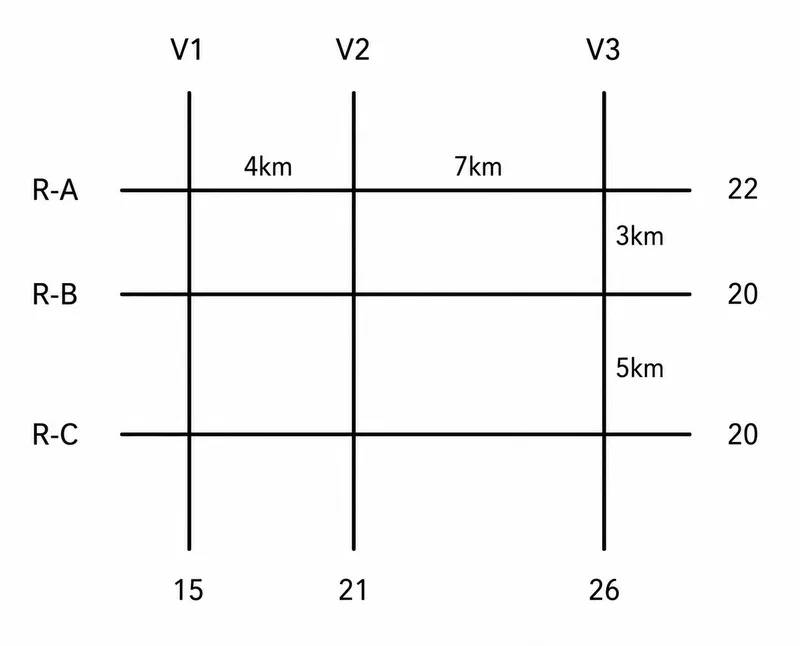
The figure below shows a network with three parallel roads represented by horizontal lines R-A, R-B, and R-C and another three parallel roads represented by vertical lines V1, V2, and V3. The figure also shows the distance (in km) between two adjacent intersections. Six ATMs are placed at six of the nine road intersections.
Each ATM has a distinct integer cash requirement (in Rs. Lakhs), and the numbers at the end of each line in the figure indicate the total cash requirements of all ATMs placed on the corresponding road. For example, the total cash requirement of the ATM(s) placed on road R-A is Rs. 22 Lakhs.
The following additional information is known:
1. The ATMs with the minimum and maximum cash requirements of Rs. 7 Lakhs and Rs. 15 Lakhs are placed on the same road.
2. The road distance between the ATM with the second highest cash requirement and the ATM located at the intersection of R-C and V3 is 12 km.
Which of the following statements is correct?
Correct Answer :
The ATM placed at the (R-C, V2) intersection has a cash requirement of Rs. 9 Lakhs.
Solution :
The correct option is:
The ATM placed at the (R-C, V2) intersection has a cash requirement of Rs. 9 Lakhs.
Let us break down the step-by-step logical and mathematical derivation to understand why this option is correct:
Step 1: Understand the Grid and Cash Requirements
From the grid image, we observe three horizontal roads (, , and ) and three vertical roads (, , and ). The row and column sums represent the total cash requirement (in Rs. Lakhs) of the ATMs on those roads:
Row sums (horizontal roads):
, ,
Column sums (vertical roads):
, ,
The grand total cash requirement is:
There are possible intersections in the grid, but exactly ATMs are placed, meaning intersections have no ATM (cash requirement of ). The ATMs have distinct integer cash requirements.
Step 2: Determine the Set of Cash Requirements
According to Clue 1, the minimum and maximum cash requirements are Lakhs and Lakhs, respectively.
Therefore, the ATM requirements must be distinct integers selected from the set , with and strictly included.
Let the sum of the remaining distinct requirements be:
We need to select distinct integers from that sum to exactly .
Thus, must be included. Working with the remaining set, we find two possible combinations:
Step 3: Analyze Distances and Locate the Second Highest ATM
Clue 2 states that the road distance between the ATM with the second highest requirement and the ATM located at the intersection of and is exactly .
From the grid image, the road distances between adjacent lines are:
Horizontal distances: Between and is ; between and is .
Vertical distances: Between and is ; between and is .
Let us find which intersection is at a road distance of from :
The distance from to going along the grid roads is:
No other intersection has a road distance of exactly from .
Step 4: Place the Min and Max ATMs
According to Clue 1, the minimum ( Lakhs) and maximum ( Lakhs) requirements are on the same road.
- They cannot be on (sum ) or (sum ) because , which exceeds those sums.
- If they are on (sum ), the third intersection on would need to have Lakhs, which is not and not in our ATM requirement sets (minimum ATM requirement is ).
- They cannot be on or since both have a sum of , which is less than .
Therefore, the and Lakhs ATMs must both be located on road (sum ).
Since , the third intersection on must have a requirement of (meaning no ATM is placed there).
Since the second highest ATM is at , let us analyze the vertical road (sum ):
Since 's ATM at must be either , , or :
Step 5: Differentiate between Case A and Case B
If Case A is correct:
The second highest is , so .
Then .
Since , the other two intersections on are and in some order.
- If , then because the column sum of is , the other two intersections on must be . For row (sum ), we get . But is already used on , violating the requirement that all ATM values must be distinct.
- If , then the remaining sum on is . Since we already have at , the only way to get a sum of on without duplicating the value is to have and at and . If , then row sum is , which is impossible.
Hence, Case A is impossible.
If Case B is correct:
The ATM requirements are .
The second highest value is , so .
Thus, the requirement at the intersection is:
This configuration is fully consistent and yields the unique solution:
Access expert-curated educational resources and study materials—completely free.
Create, conduct, and manage professional online assessments with Mindyard. Perfect for teachers and institutes.
Copyright © 2026 Mindyard. All Rights Reserved.




