
Comprehension Passage:
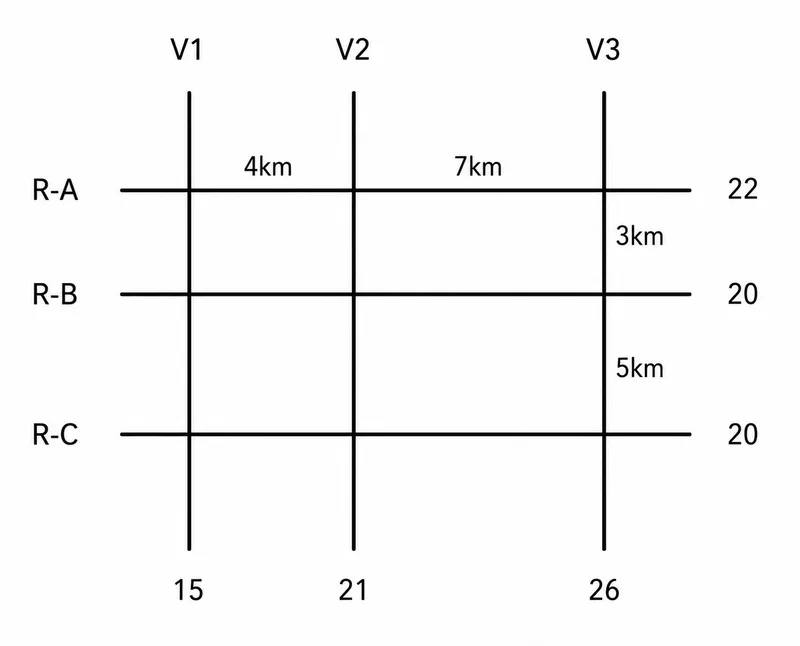
The figure below shows a network with three parallel roads represented by horizontal lines R-A, R-B, and R-C and another three parallel roads represented by vertical lines V1, V2, and V3. The figure also shows the distance (in km) between two adjacent intersections. Six ATMs are placed at six of the nine road intersections.
Each ATM has a distinct integer cash requirement (in Rs. Lakhs), and the numbers at the end of each line in the figure indicate the total cash requirements of all ATMs placed on the corresponding road. For example, the total cash requirement of the ATM(s) placed on road R-A is Rs. 22 Lakhs.
The following additional information is known:
1. The ATMs with the minimum and maximum cash requirements of Rs. 7 Lakhs and Rs. 15 Lakhs are placed on the same road.
2. The road distance between the ATM with the second highest cash requirement and the ATM located at the intersection of R-C and V3 is 12 km.
What best can be said about the road distance (in km) between the ATMs having the second highest and the second lowest cash requirements?
Solution :
The correct option is Either 4 km or 7 km.
Step-by-Step Analysis & Derivation:
1. Understanding the Road Network and Distances:
From the provided image, we can identify the following parameters of the grid network:
• Three horizontal roads: R-A, R-B, and R-C with cash totals of 22, 20, and 20 (Rs. Lakhs) respectively.
• Three vertical roads: V1, V2, and V3 with cash totals of 15, 21, and 26 (Rs. Lakhs) respectively.
• The horizontal distance between V1 and V2 is 4 km, and between V2 and V3 is 7 km. Thus, the total horizontal distance between V1 and V3 is:
• The vertical distance between R-A and R-B is 3 km, and between R-B and R-C is 5 km. Thus, the total vertical distance between R-A and R-C is:
2. Determining the ATM Cash Requirements:
We are given that 6 ATMs are placed at 6 of the 9 intersections. Each ATM has a distinct integer cash requirement.
Let the 6 distinct cash requirements be ordered as:
We are given that the minimum cash requirement is:
And the maximum cash requirement is:
The total cash requirement of all roads combined is:
Thus, the sum of the remaining 4 ATM values is:
These 4 distinct integers must be chosen from the set:
To sum to 40, there are only two valid sets of 4 integers:
• Case A: 8, 9, 10, and 13 (The 6 ATM values are 7, 8, 9, 10, 13, and 15)
• Case B: 8, 9, 11, and 12 (The 6 ATM values are 7, 8, 9, 11, 12, and 15)
3. Pinpointing ATM Locations:
• Constraint 1: The minimum (7) and maximum (15) ATMs are on the same road.
Since their sum is 22, they must lie either on R-A (total 22) or on V3 (total 26).
• Constraint 2: The road distance between the ATM with the second highest cash requirement and the ATM located at the intersection of R-C and V3 is 12 km.
Let us find the intersection that is exactly 12 km away from the intersection of R-C and V3:
- From R-C/V3 to R-B/V2, the distance is:
No other intersection has a road distance of exactly 12 km. Thus, the ATM with the second highest cash requirement (which is either 13 or 12) is located at the intersection of R-B and V2.
4. Finding the Road Distance Between the Second Highest and Second Lowest ATMs:
Using the conditions above, we can determine the exact configurations:
• If the minimum (7) and maximum (15) are placed on R-A, then R-A has these two ATMs, and the third intersection is empty. Since B2 (V2) has a value of 12 or 13, the other ATM on V2 must be at C2. This leads to the only possible valid configuration (Case B, where the second highest is 12):
Sub-case 4.1:
- ATMs on R-A: 7 (at V1) and 15 (at V3)
- ATMs on R-B: 8 (at V1) and 12 (at V2)
- ATMs on R-C: 9 (at V2) and 11 (at V3)
In this configuration, the second lowest ATM (8) is at R-B, V1 and the second highest ATM (12) is at R-B, V2.
The road distance between them is the horizontal distance between V1 and V2, which is 4 km.
Sub-case 4.2:
- ATMs on R-A: 15 (at V1) and 7 (at V3)
- ATMs on R-B: 12 (at V2) and 8 (at V3)
- ATMs on R-C: 9 (at V2) and 11 (at V3)
In this configuration, the second lowest ATM (8) is at R-B, V3 and the second highest ATM (12) is at R-B, V2.
The road distance between them is the horizontal distance between V2 and V3, which is 7 km.
Completely free for students. Educators & coaching institutes get 2 months free Pro trial to create tests.
Access unlimited practice questions, detailed step-by-step solutions, and exam study materials — completely free for students.
Create and conduct professional online assessments with AI question generation, tab proctoring, and comprehensive batch management.

Practice the complete CLAT 2015 UG Question Paper to improve your preparation for the Common Law Admission Test. This previous year paper covers the key sections of CLAT UG, including English, General Knowledge & Current Affairs, Elementary Mathematics, Legal Aptitude, and Logical Reasoning. Solve CLAT 2015 UG questions to understand the previous year exam pattern, practice important concepts, improve accuracy and speed, and prepare effectively for law entrance examinations.

Prepare for CLAT 2019 UG with the complete question paper and solutions. This paper covers all major sections of the Common Law Admission Test (CLAT) Undergraduate exam, including English Language, Current Affairs & General Knowledge, Legal Reasoning, Logical Reasoning, and Quantitative Techniques.Use the CLAT 2019 UG question paper to practice exam-level questions, understand the question pattern, improve time management, and strengthen your preparation for law entrance examinations.
Copyright © 2026 Combe Labs Private Limited. All Rights Reserved.


