
Consider a circuit consisting of a capacitor of capacitance C and a coil with N turns per unit length, cross sectional area S and length d, where d2 >> S. There is another coil of length , cross sectional area and 2N turns per unit length completely inside the larger coil, as shown in the figure. The ends of this smaller coil are connected with each other by an insulated conducting wire. The self-inductance of the larger coil is L. Neglecting edge effects and all the Ohmic resistances, the resonant frequency of the circuit is:
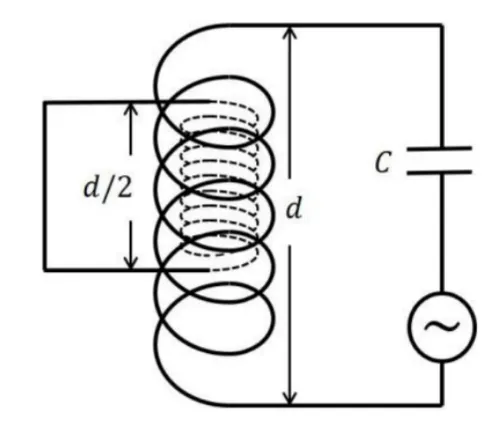
Solution :
The correct option is .
Step 1: Understand the system parameters
Let the larger coil (coil 1) have:
- Length:
- Cross-sectional area:
- Turns per unit length:
- Total turns:
- Self-inductance:
For the smaller inner coil (coil 2):
- Length:
- Cross-sectional area:
- Turns per unit length:
- Total turns:
Step 2: Calculate the self-inductance of coil 2 ()
The self-inductance of the smaller inner coil is:
Step 3: Calculate the mutual inductance () between the two coils
Since coil 2 is completely inside coil 1 of length , the magnetic field created inside by current in coil 1 is uniform: .
The total magnetic flux passing through all turns of coil 2 is:
Thus, the mutual inductance is:
Step 4: Find the effective inductance of the combination
Let be the alternating current flowing through the outer circuit containing the capacitor , and be the induced current in the short-circuited inner coil.
For the inner short-circuited coil (neglecting Ohmic resistance):
Integrating gives:
The total back EMF induced across the outer coil (coil 1) is given by:
Substituting and :
Step 5: Calculate the resonant frequency
The resonant frequency of an LC circuit is given by:
Substituting :
... wait, simplifying .
Thus, the resonant frequency of the circuit is as given in the option.
Completely free for students. Educators & coaching institutes get 2 months free Pro trial to create tests.
Access unlimited practice questions, detailed step-by-step solutions, and exam study materials — completely free for students.
Create and conduct professional online assessments with AI question generation, tab proctoring, and comprehensive batch management.

A comprehensive JEE Advanced 2022 Paper 1 designed to help aspirants understand the examination pattern, difficulty level, and question trends of JEE Advanced. This paper covers important concepts from Physics, Chemistry, and Mathematics, featuring a balanced mix of conceptual, numerical, and advanced application-based questions. It helps students strengthen conceptual understanding, enhance analytical and problem-solving skills, and improve speed and accuracy. Ideal for practice, revision, self-assessment, previous year trend analysis, concept reinforcement, and time management, this paper is a valuable resource for effective JEE Advanced preparation.

A comprehensive JEE Advanced 2022 Paper 2 designed to help aspirants understand the examination pattern, difficulty level, and question trends of JEE Advanced. This paper covers important concepts from Physics, Chemistry, and Mathematics, featuring a balanced mix of conceptual, numerical, and advanced application-based questions. It helps students strengthen conceptual understanding, enhance analytical and problem-solving skills, and improve speed and accuracy. Ideal for practice, revision, self-assessment, previous year trend analysis, concept reinforcement, and time management, this paper is a valuable resource for effective JEE Advanced preparation.
Copyright © 2026 Combe Labs Private Limited. All Rights Reserved.


