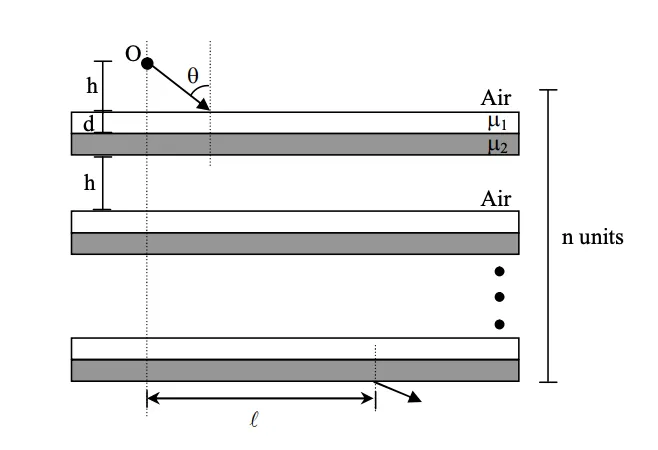
Consider a configuration of identical units, each consisting of three layers. The first layer is a column of air of height , and the second and third layers are of equal thickness , and refractive indices and , respectively. A light source O is placed on the top of the first unit, as shown in the figure. A ray of light from O is incident on the second layer of the first unit at angle of to the normal. For a specific value of , the ray of light emerges from the bottom of the configuration at a distance , as shown in the figure. The value of is _____.
Correct Answer :
Solution :
The correct answer is 4.
Step-by-Step Explanation:
From the given image, we observe a configuration of identical units stacked vertically. Each unit consists of three layers:
1. An air layer of height and refractive index .
2. A medium of thickness and refractive index .
3. A medium of thickness and refractive index .
1. Angle of refraction in each layer:
Let be the incident angle in air ().
Using Snell's Law across the interfaces:
For the first layer (air):
The ray travels in air at angle to the normal across a height . The horizontal displacement in air per unit, , is:
For the second layer (refractive index ):
The horizontal displacement in this layer, , is:
For the third layer (refractive index ):
The horizontal displacement in this layer, , is:
2. Total horizontal shift per unit ():
The total horizontal shift introduced by one single unit consisting of air, medium 1, and medium 2 is:
Taking as the common denominator:
3. Finding the number of units ():
As shown in the image, the ray enters the top of the first unit at a horizontal position directly below point and emerges at the bottom of the configuration after passing through identical units at a total horizontal distance .
Thus, the value of is 4.
Access expert-curated educational resources and study materials—completely free.
Create, conduct, and manage professional online assessments with Mindyard. Perfect for teachers and institutes.
Copyright © 2026 Mindyard. All Rights Reserved.