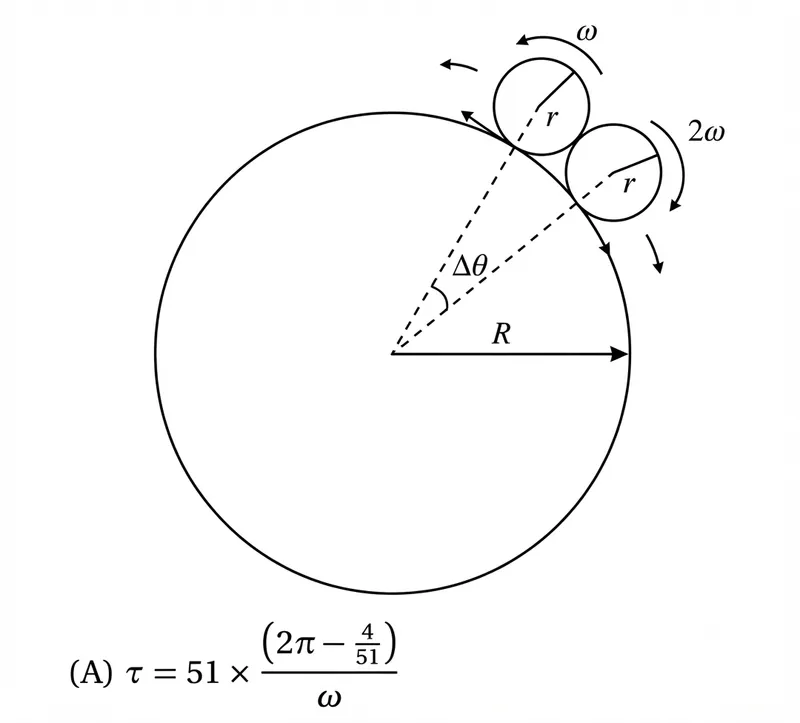
Consider a large disk of radius and two smaller disks, each of radius lying on its circumference, as shown in the figure. The smaller disks are initially in contact with each other, with an angular separation between their centers. They are made to roll without slipping in opposite directions, with constant angular velocities and while the large disk is held stationary. The time at which the smaller disks are again in contact is:
[Use and ignore gravity.]
Correct Answer :
Solution :
The correct option is:
Step 1: Determine the initial angular separation
As shown in the figure, two smaller disks of radius are placed externally on the circumference of a large disk of radius , in contact with each other.
The distance from the center of the large disk to the center of each smaller disk is .
When the two small disks touch, the distance between their centers is .
Using geometry, for the angle subtended at the center of the large disk:
Given that , we have:
Substituting this ratio into the sine expression:
Using the small-angle approximation :
Step 2: Relate linear motion (rolling without slipping) to angular motion along the circumference
The smaller disks roll without slipping on the stationary large disk.
For a small disk rolling with angular speed , the speed of its contact point relative to its center is .
Since the large disk is held stationary, the velocity of the center of the small disk along the circular path is:
The rate of change of the position angle of the center of the small disk about the center of the large disk is:
Step 3: Calculate the relative angular velocity
The two small disks move in opposite directions along the circumference of the large disk with angular spin speeds and .
Their respective orbital angular speeds around the center of the large disk are:
Since they move in opposite directions, the total relative angular speed at which the angle between their centers increases is:
Step 4: Calculate the time required to meet again
Initially, the disks are at an angular separation of .
To come into contact again after traveling around the large disk, the total relative angular distance covered by their centers around the large disk must be .
Therefore, the required time is given by:
Access expert-curated educational resources and study materials—completely free.
Create, conduct, and manage professional online assessments with Mindyard. Perfect for teachers and institutes.
Copyright © 2026 Mindyard. All Rights Reserved.