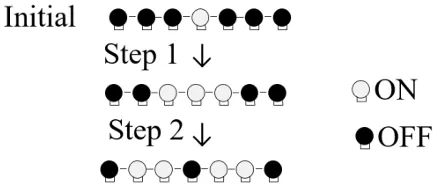
Consider a linear arrangement of seven bulbs, each of which can be in the ON or OFF states. The initial configuration of the bulbs is shown in the figure. In every Step, the states of the bulbs are changed based on the following rules:
• Any OFF bulb with exactly one ON neighbor at the end of the previous Step is turned ON.
• Any ON bulb with both neighbors ON at the end of the previous Step is turned OFF.
• The state of any bulb not meeting the conditions above is left unchanged.
The state of bulbs at the end of Step 1 and Step 2 are also shown in the figure. The number of bulbs which are ON at the end of Step 8 is
Correct Answer :
4
Solution :
The correct answer is 4.
Let us represent the state of each bulb using binary values, where 1 represents an ON bulb (light gray in the figure) and 0 represents an OFF bulb (black in the figure). Since there are seven bulbs in a linear arrangement, the state of the system can be written as a sequence of seven digits from left to right: (Bulb1, Bulb2, Bulb3, Bulb4, Bulb5, Bulb6, Bulb7).
The rules for transition in each step are as follows:
1. Any OFF (0) bulb turns ON (1) if and only if it has exactly one neighbor that was ON (1) in the previous step.
2. Any ON (1) bulb turns OFF (0) if and only if both of its neighbors were ON (1) in the previous step. (Note: The boundary bulbs, Bulb1 and Bulb7, only have one neighbor each, so they can never have "both neighbors ON" and therefore cannot be turned OFF by this rule).
3. The state of any bulb that does not meet the above conditions remains unchanged.
Let us trace the state of the bulbs step-by-step:
Initial State:
As shown in the figure, only the middle bulb (Bulb4) is ON.
Configuration: 0 0 0 1 0 0 0
Step 1:
• Bulb1 (0): Neighbor Bulb2 is 0 → Stays 0.
• Bulb2 (0): Neighbors are 0 and 0 → Stays 0.
• Bulb3 (0): Neighbors are 0 and 1 (exactly one ON neighbor) → Turns 1.
• Bulb4 (1): Neighbors are 0 and 0 (not both ON) → Stays 1.
• Bulb5 (0): Neighbors are 1 and 0 (exactly one ON neighbor) → Turns 1.
• Bulb6 (0): Neighbors are 0 and 0 → Stays 0.
• Bulb7 (0): Neighbor Bulb6 is 0 → Stays 0.
Configuration: 0 0 1 1 1 0 0 (Matches Step 1 in the figure)
Step 2:
• Bulb1 (0): Neighbor Bulb2 is 0 → Stays 0.
• Bulb2 (0): Neighbors are 0 and 1 (exactly one ON neighbor) �� Turns 1.
• Bulb3 (1): Neighbors are 0 and 1 (not both ON) → Stays 1.
• Bulb4 (1): Neighbors are 1 and 1 (both neighbors ON) → Turns 0.
• Bulb5 (1): Neighbors are 1 and 0 (not both ON) → Stays 1.
• Bulb6 (0): Neighbors are 1 and 0 (exactly one ON neighbor) → Turns 1.
• Bulb7 (0): Neighbor Bulb6 is 0 → Stays 0.
Configuration: 0 1 1 0 1 1 0 (Matches Step 2 in the figure)
Step 3:
• Bulb1 (0): Neighbor Bulb2 is 1 (exactly one ON neighbor) → Turns 1.
• Bulb2 (1): Neighbors are 0 and 1 (not both ON) → Stays 1.
• Bulb3 (1): Neighbors are 1 and 0 (not both ON) → Stays 1.
• Bulb4 (0): Neighbors are 1 and 1 (not exactly one ON neighbor) → Stays 0.
• Bulb5 (1): Neighbors are 0 and 1 (not both ON) → Stays 1.
• Bulb6 (1): Neighbors are 1 and 0 (not both ON) → Stays 1.
• Bulb7 (0): Neighbor Bulb6 is 1 (exactly one ON neighbor) → Turns 1.
Configuration: 1 1 1 0 1 1 1
Step 4:
• Bulb1 (1): Neighbor Bulb2 is 1 → Stays 1 (boundary bulb).
• Bulb2 (1): Neighbors are 1 and 1 (both neighbors ON) → Turns 0.
• Bulb3 (1): Neighbors are 1 and 0 (not both ON) → Stays 1.
• Bulb4 (0): Neighbors are 1 and 1 (not exactly one ON neighbor) → Stays 0.
• Bulb5 (1): Neighbors are 0 and 1 (not both ON) → Stays 1.
• Bulb6 (1): Neighbors are 1 and 1 (both neighbors ON) → Turns 0.
• Bulb7 (1): Neighbor Bulb6 is 1 → Stays 1 (boundary bulb).
Configuration: 1 0 1 0 1 0 1
Step 5:
• Bulb1 (1): Neighbor Bulb2 is 0 → Stays 1.
• Bulb2 (0): Neighbors are 1 and 1 (two ON neighbors, not exactly one) → Stays 0.
• Bulb3 (1): Neighbors are 0 and 0 → Stays 1.
• Bulb4 (0): Neighbors are 1 and 1 → Stays 0.
• Bulb5 (1): Neighbors are 0 and 0 → Stays 1.
• Bulb6 (0): Neighbors are 1 and 1 → Stays 0.
• Bulb7 (1): Neighbor Bulb6 is 0 → Stays 1.
Configuration: 1 0 1 0 1 0 1
Since the configuration at the end of Step 5 is identical to the configuration at the end of Step 4 (1 0 1 0 1 0 1), the system has reached a stable steady state. It will not change in any of the subsequent steps.
Therefore, the configuration at the end of Step 8 remains:
1 0 1 0 1 0 1
Counting the number of bulbs that are ON (1s) in this final configuration:
Bulb1, Bulb3, Bulb5, and Bulb7 are ON, which gives a total of 4 bulbs.
Access expert-curated educational resources and study materials—completely free.
Create, conduct, and manage professional online assessments with Mindyard. Perfect for teachers and institutes.
Copyright © 2026 Mindyard. All Rights Reserved.