Consider a one-dimensional steady heat conduction process through a solid slab of thickness 0.1 m. The higher temperature side A has a surface temperature of 80 °C, and the heat transfer rate per unit area to low temperature side B is 4.5 kW/m2. The thermal conductivity of the slab is 15 W/m.K. The rate of entropy generation per unit area during the heat transfer process is ________ W/m2 .K (round off to 2 decimal places).
Correct Answer :
Correct answer is : 1.184
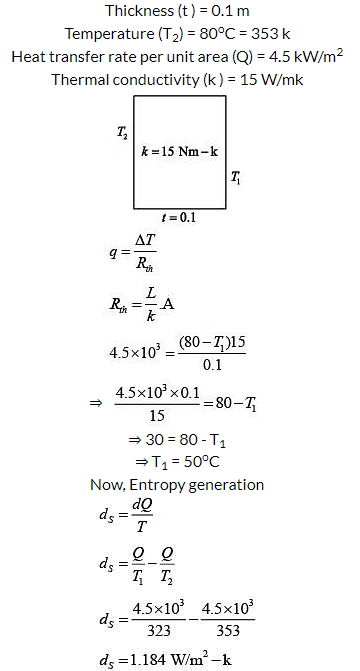
Solution :
The correct answer is 1.184.
Based on the text and diagram in the provided image, we have the following parameters for the one-dimensional steady heat conduction process:
- Thickness of the slab (L) = 0.1 m
- Surface temperature of side A (higher temperature, TA) = 80 °C = 80 + 273 = 353 K
- Heat transfer rate per unit area (q) = 4.5 kW/m2 = 4500 W/m2
- Thermal conductivity of the slab (k) = 15 W/m·K
First, we use Fourier's law of heat conduction to find the temperature of the lower temperature side B (TB):
Substituting the given values:
Rearranging to solve for the temperature difference:
Converting the temperature of side B to Kelvin:
During steady heat transfer, the rate of entropy generation per unit area (ṡgen) is calculated by performing an entropy balance across the control volume of the slab:
Substituting the values of heat flux and absolute temperatures:
Calculating each term:
Subtracting the entropy flow out from the entropy flow in:
Thus, the rate of entropy generation per unit area is 1.184 W/m2·K.
Access expert-curated educational resources and study materials—completely free.
Create, conduct, and manage professional online assessments with Mindyard. Perfect for teachers and institutes.
Copyright © 2026 Mindyard. All Rights Reserved.