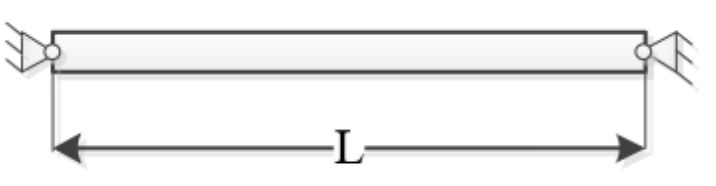
Consider a prismatic straight beam of length L = π m, pinned at the two ends as shown in the figure. The beam has a square cross-section of side p = 6 mm. The Young’s modulus E = 200 GPa, and the coefficient of thermal expansion α = 3•10–6K–1. The minimum temperature rise required to cause Euler buckling of the beam is _____K.
Correct Answer :
Solution :
The correct answer is 1.
To find the minimum temperature rise required to cause Euler buckling of the beam, we equate the axial compressive force generated by thermal expansion to the Euler critical buckling load of the beam.
1. Euler Critical Buckling Load:
For a straight beam pinned at both ends, the critical buckling load is given by Euler's buckling formula:
where:
Given that the length of the beam is , the critical buckling load simplifies to:
2. Thermal Compressive Force:
When the temperature of the beam is increased by , the tendency of the beam to expand is restricted by the supports at its ends. This restriction induces a compressive thermal strain:
The corresponding compressive thermal stress is:
The axial force generated due to the thermal expansion is the stress multiplied by the cross-sectional area :
3. Buckling Condition:
Buckling occurs when the thermal load equals the critical buckling load:
Substituting the expressions, we get:
Solving for :
4. Geometric Properties of a Square Cross-section:
For a square cross-section of side side :
The cross-sectional area is:
The area moment of inertia is:
Substituting these into the equation for yields:
5. Substituting the Values:
Given parameters from the problem statement and the visible layout in the image:
Thus, the minimum temperature rise required to cause Euler buckling is 1 K.
Access expert-curated educational resources and study materials—completely free.
Create, conduct, and manage professional online assessments with Mindyard. Perfect for teachers and institutes.
Copyright © 2026 Mindyard. All Rights Reserved.