
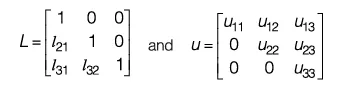
Consider a system of linear equations PX=Q where P ∈ R3x3 and Q∈R3x3. Suppose P has an LU decomposition, P=LU, where
Which of the following statement(s) is/are TRUE?
Correct Answer :
The system PX=Q can be solved by first solving LY=Q and then UX=Y.
If P is invertible, then both L and U are invertible.
If P is singular, then at least one of the diagonal elements of U is zero.
Solution :
The correct statements are:
1. The system PX=Q can be solved by first solving LY=Q and then UX=Y.
2. If P is invertible, then both L and U are invertible.
3. If P is singular, then at least one of the diagonal elements of U is zero.
From the provided image, we have a system of linear equations where a matrix has an LU decomposition .
The lower triangular matrix is given by:
and the upper triangular matrix is given by:
Step 1: Analyzing the solution method of the system (Statement 1)
We are given the system:
Substituting into the equation gives:
By matrix associativity, we can write:
Let us define an intermediate variable matrix . The system splits into two sequential steps:
1. Solve the lower-triangular system for using forward substitution.
2. Solve the upper-triangular system for using back substitution.
Hence, this statement is TRUE.
Step 2: Determinant relations and invertibility (Statement 2)
The determinant of the product of two square matrices is the product of their determinants:
If is invertible, its determinant is non-zero:
Consequently:
Because their determinants are non-zero, both and must be invertible.
Hence, this statement is TRUE.
Step 3: Singular matrix properties (Statement 3)
If is singular, its determinant is zero:
For a triangular matrix, the determinant is the product of the diagonal elements.
The diagonal elements of are all equal to 1, as shown in the image. Therefore:
Since , it must be that:
The determinant of is the product of its diagonal elements:
This product is zero if and only if at least one of the diagonal elements (, , or ) is zero.
Hence, this statement is TRUE.
Access expert-curated educational resources and study materials—completely free.
Create, conduct, and manage professional online assessments with Mindyard. Perfect for teachers and institutes.
Copyright © 2026 Mindyard. All Rights Reserved.




