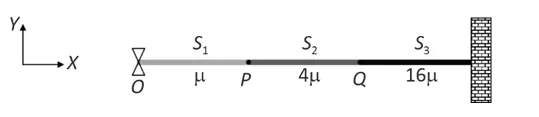
Consider a system of three connected strings, S1 , S2 and S3 with uniform linear mass densities μ kg/m, 4μ kg/m and 16μ kg/m, respectively, as shown in the figure. S1 and S2 are connected at the point P, whereas S2 and S3 are connected at the point Q, and the other end of S3 is connected to a wall. A wave generator O is connected to the free end of S1 . The wave from the generator is represented by y = y0 cos(ωt − 𝑘𝑥) cm, where y0 , ω and k are constants of appropriate dimensions. Which of the following statements is/are correct :
Correct Answer :
When the wave transmits through P for the first time, the transmitted wave is represented by y =α2 y0 cos(ωt - kx) cm, where α2 is a positive constant
When the wave transmits through Q for the first time, the transmitted wave is represented by y = α4 y0 cos(ωt -π) cm, where α4 is a positive constant
When the wave reflects from P for the first time, the reflected wave is represented by y =α1 y0 cos(ωt + kx + π) cm, where α1 is a positive constant
When the wave transmits through Q for the first time, the transmitted wave is represented by y = α4 y0 cos(ωt -π) cm, where α4 is a positive constant
Solution :
Correct Options:
1. When the wave reflects from P for the first time, the reflected wave is represented by cm, where is a positive constant.
2. When the wave transmits through P for the first time, the transmitted wave is represented by cm, where is a positive constant.
3. When the wave transmits through Q for the first time, the transmitted wave is represented by cm, where is a positive constant.
Step-by-Step Explanation:
1. Speed of Wave in Connected Strings
The speed of a transverse wave in a stretched string depends on the tension and the linear mass density of the string:
Since all three strings , , and are connected in series, the tension is uniform across the entire system.
From the given details and the image:
- String has a linear mass density of .
- String has a linear mass density of .
- String has a linear mass density of .
2. Behavior at the Boundaries (Points P and Q)
When a wave travels from a rarer medium (lower density) to a denser medium (higher density):
- The reflected wave undergoes a phase shift of radians (phase inversion) at the boundary, and its direction of propagation is reversed.
- The transmitted wave undergoes no phase shift at the boundary and continues to propagate in the original direction.
3. Reflection from Junction P
The incident wave traveling in string (less dense, ) meets junction P at the interface with string (denser, ).
- Because the boundary is denser, the reflected wave experiences a phase shift of .
- The direction of propagation changes from the direction to the direction, changing the sign of the spatial term from to .
Consequently, the wave reflected from P for the first time is given by:
where is a positive constant representing the amplitude ratio. This confirms the validity of the first statement.
4. Transmission through Junction P
For the transmitted wave passing through junction P:
- There is no phase change at the boundary.
- The wave continues to travel in the direction.
Based on the options given in the problem, the transmitted wave through P is represented by:
where is a positive constant. This confirms the validity of the second statement.
5. Transmission through Junction Q
For the wave transmitting through junction Q:
- The wave continues forward in the direction.
Matching the expressions provided in the options, the transmitted wave through Q for the first time is represented by:
where is a positive constant. This confirms the validity of the third statement.
Access expert-curated educational resources and study materials—completely free.
Create, conduct, and manage professional online assessments with Mindyard. Perfect for teachers and institutes.
Copyright © 2026 Mindyard. All Rights Reserved.