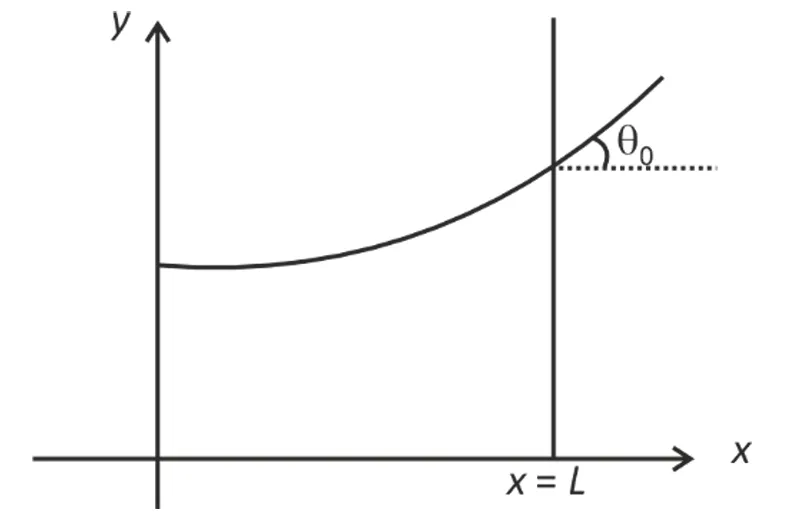
Consider a water tank shown in the figure. It has one wall at x = L and can be taken to be very wide in the z direction. When filled with a liquid of surface tension S and density ρ, the liquid surface makes angle θ0 (θ0 << 1) with the x-axis at x = L. If y(x) is the height of the surface then the equation for y(x) is:
Correct Answer :
Solution :
Correct Answer:
The correct equation for the surface profile is:
Step-by-Step Explanation:
1. Image Analysis:
From the provided image, we can see the profile of a liquid surface in a tank. The coordinate axes are set such that the horizontal axis represents distance and the vertical axis represents height . There is a vertical wall located at . The liquid surface rises as it approaches the wall, forming a meniscus. At the boundary wall , the tangent to the liquid surface forms a small contact angle with the horizontal line (dashed line parallel to the x-axis).
2. Laplace Pressure across a Curved Interface:
According to the Young-Laplace equation, the difference in pressure across a curved liquid-gas interface is related to the surface tension and the local radius of curvature of the interface. The pressure just below the surface is less than the atmospheric pressure above the surface by:
3. Curvature in the Small-Angle Approximation:
For a one-dimensional surface profile defined by the curve , the exact expression for the curvature is:
4. Hydrostatic Balance:
At any point along the interface with height relative to the flat liquid level far away (where and ), the pressure inside the liquid is governed by hydrostatic balance:
5. Formulating the Differential Equation:
By equating the Laplace pressure difference to the hydrostatic pressure difference:
Access expert-curated educational resources and study materials—completely free.
Create, conduct, and manage professional online assessments with Mindyard. Perfect for teachers and institutes.
Copyright © 2026 Mindyard. All Rights Reserved.