Consider an elastic straight beam of length L = 10π m, with square cross-section of side a = 5 mm, and Young’s modulus E = 200 GPa. This straight beam was bent in such a way that the two ends meet, to form a circle of mean radius R. Assuming that Euler-Bernoulli beam theory is applicable to this bending problem, the maximum tensile bending stress in the bent beam is _________ MPa.
Solution :
The correct answer is 100.
Step-by-step Explanation:
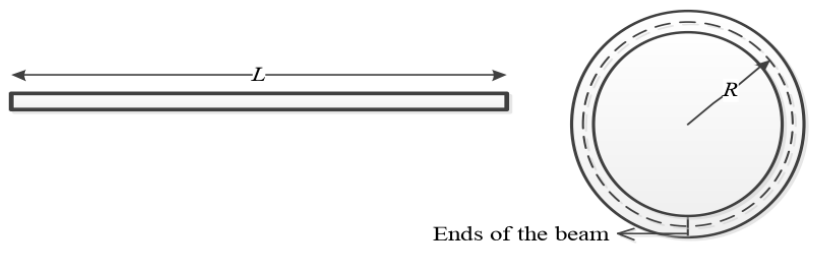
As shown in the provided illustration, a straight elastic beam of length (left) is bent until its ends meet, forming a closed circle of mean radius (right), with the point of contact labeled as "Ends of the beam".
First, we relate the length of the beam to the geometry of the circle. Since the beam is bent to form a complete circle, the length of the beam is equal to the circumference of the circle:
Given:
We can solve for the mean radius :
According to the Euler-Bernoulli beam theory, the bending stress at any distance from the neutral axis is given by the bending relation:
where:
• is the Young's modulus of the material,
• is the radius of curvature (which is the mean radius of the circle, m).
The maximum bending stress (maximum tensile stress on the outer fiber) occurs at the maximum distance from the neutral axis, . For a square cross-section of side :
Given the side of the square cross-section is mm:
The Young's modulus is given as .
Now, we calculate the maximum bending stress :
Thus, the maximum tensile bending stress in the bent beam is 100 MPa.
Completely free for students. Educators & coaching institutes get 2 months free Pro trial to create tests.
Access unlimited practice questions, detailed step-by-step solutions, and exam study materials — completely free for students.
Create and conduct professional online assessments with AI question generation, tab proctoring, and comprehensive batch management.
The GATE 2026 Mechanical Engineering (ME) examination scheduled for 14 February 2026 is one of the most important national-level competitive exams for engineering graduates aspiring for higher education and prestigious career opportunities in PSU and research organizations. Conducted annually at the national level, the GATE Mechanical Engineering paper evaluates candidates on core subjects such as Engineering Mechanics, Thermodynamics, Fluid Mechanics, Strength of Materials, Manufacturing Processes, and Machine Design, along with General Aptitude and Engineering Mathematics. This examination is a gateway for admission into M.Tech/Ph.D. programs at IITs, NITs, IISc, and other top institutions, as well as recruitment in major Public Sector Undertakings (PSUs) like ONGC, NTPC, BHEL, IOCL, and more. The GATE ME 2026 paper will test conceptual understanding, analytical thinking, and problem-solving ability, making strong preparation essential for success. Candidates are advised to practice previous year papers, mock tests, and focus on conceptual clarity for high scoring performance. This exam on 14/02/2026 is a crucial opportunity for mechanical engineering aspirants to secure their future in academia and industry.
Strengthen your preparation with this GATE 2025 Mechanical Engineering (ME) test, covering core subjects such as thermodynamics, fluid mechanics, strength of materials, theory of machines, and manufacturing engineering. With a well-balanced mix of conceptual and numerical questions, this test helps enhance problem-solving ability and technical understanding. Aligned with the latest exam pattern, it is ideal for improving accuracy, speed, and overall exam readiness.
Copyright © 2026 Combe Labs Private Limited. All Rights Reserved.