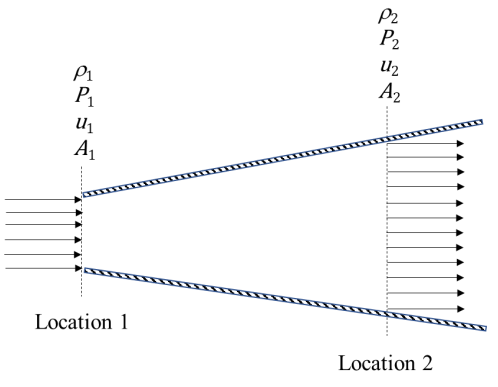
Consider an isentropic flow of air (ratio of specific heats = 1.4) through a duct as shown in the figure.
The variations in the flow across the cross-section are negligible. The flow conditions at Location 1 are given as follows:
𝑃1 = 100 kPa, 𝜌1 = 1.2 kg/m3 , 𝑢1= 400 m/s
The duct cross-sectional area at Location 2 is given by A2 = 2A1, where A1 denotes the duct cross-sectional area at Location 1. Which one of the given statements about the velocity 𝑢2 and pressure 𝑃2 at Location 2 is TRUE?
Correct Answer :
𝑢2 > 𝑢1 , 𝑃2 < 𝑃1
Solution :
The correct option is:
𝑢2 > 𝑢1 , 𝑃2 < 𝑃1
Step-by-Step Explanation:
Step 1: Identify the flow conditions at Location 1
We are given the following conditions at Location 1 (as seen in the diagram):
Pressure, 𝑃1 = 100 kPa = 100,000 Pa
Density, 𝜌1 = 1.2 kg/m3
Velocity, 𝑢1 = 400 m/s
Ratio of specific heats, 𝛾 = 1.4
Specific gas constant for air, 𝑅 = 287 J/(kg·K)
Step 2: Determine the temperature at Location 1
Using the ideal gas equation of state:
Solving for 𝑇1:
Step 3: Calculate the local speed of sound at Location 1
Step 4: Find the Mach number at Location 1
Since 𝑀𝑎1 > 1, the flow at Location 1 is supersonic.
Step 5: Analyze the effect of the diverging duct
The relation between cross-sectional area 𝐴 and flow velocity 𝑢 in a 1D isentropic flow is given by the area-velocity relation:
From the diagram and problem description, the area increases downstream from Location 1 to Location 2 (𝐴2 = 2𝐴1), meaning:
𝑑𝐴 > 0
Since the flow is supersonic (𝑀𝑎 > 1), we have:
(𝑀𝑎2 - 1) > 0
To satisfy the relation, the velocity gradient must be positive:
𝑑𝑢 > 0 ⇒ 𝑢2 > 𝑢1
For a supersonic flow, a diverging duct acts as a nozzle, causing the fluid velocity to increase.
Step 6: Determine the pressure change
According to the 1D momentum equation (Euler's equation) for inviscid flow:
Since 𝑑𝑢 > 0, the change in pressure must be negative:
𝑑𝑃 < 0 ⇒ 𝑃2 < 𝑃1
Therefore, as the supersonic flow expands through the diverging duct, its velocity increases and its pressure decreases, verifying that:
𝑢2 > 𝑢1 , 𝑃2 < 𝑃1
Access expert-curated educational resources and study materials—completely free.
Create, conduct, and manage professional online assessments with Mindyard. Perfect for teachers and institutes.
Copyright © 2026 Mindyard. All Rights Reserved.