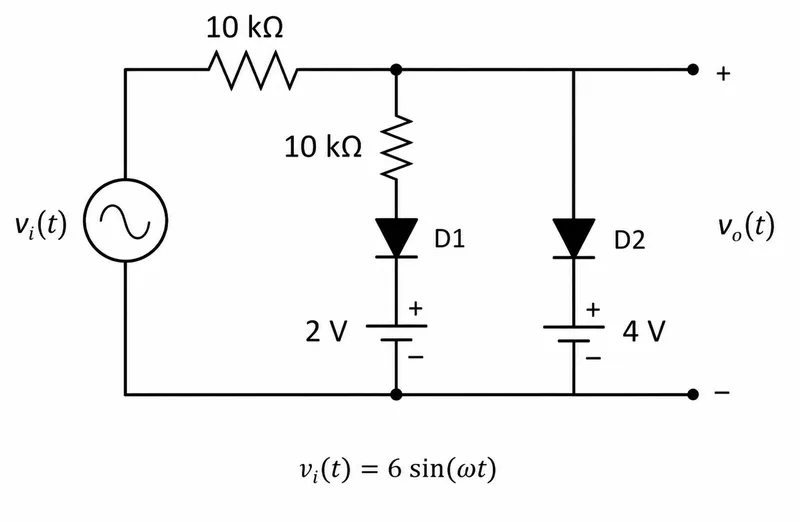
Consider ideal diodes and with cut-in voltage and in Volt. The maximum voltage (Volt) of the output is (rounded off to two decimal places).
Correct Answer :
Solution :
The correct answer is 4.00.
Analysis of the Circuit Diagram:
Based on the provided circuit diagram, we have:
- An input AC source:
which has a peak positive voltage of 6 V and a peak negative voltage of -6 V.
- A series input resistor of value:
- A first branch connected in parallel to the output containing an ideal diode D1 in series with a resistor:
and a DC battery of 2 V (with the positive terminal connected to the cathode of D1).
- A second branch in parallel containing an ideal diode D2 in series with a 4 V DC battery (with the positive terminal connected to the cathode of D2).
Step-by-Step State Analysis:
Case 1: When the output voltage is less than 2 V
If the output voltage
both diodes D1 and D2 are reverse-biased (OFF) because the potential at their anodes (the output node) is less than the potentials at their respective cathodes (2 V and 4 V).
Under this condition, no current flows through the parallel branches. Therefore, the output voltage simply tracks the input voltage:
This state continues as the input voltage rises up to 2 V.
Case 2: When the input voltage exceeds 2 V
When the input voltage
the output node voltage attempts to go above 2 V, which forward-biases the ideal diode D1, turning it ON (acting as a short circuit). Meanwhile, as long as the output voltage remains below 4 V, diode D2 remains OFF.
With D1 ON and D2 OFF, the circuit acts as a voltage divider between the input voltage source and the 2 V battery. The output voltage can be calculated as:
Substituting the resistor values
and
gives:
Determining the Maximum Output Voltage:
The maximum value of the input signal is
Substituting this peak value into our voltage divider equation:
Since the maximum output voltage is exactly 4 V, diode D2 (which has its cathode at 4 V) is on the verge of conduction but does not turn on to clamp the voltage any further. Thus, the maximum output voltage is 4.00 V.
Access expert-curated educational resources and study materials—completely free.
Create, conduct, and manage professional online assessments with Mindyard. Perfect for teachers and institutes.
Copyright © 2026 Mindyard. All Rights Reserved.