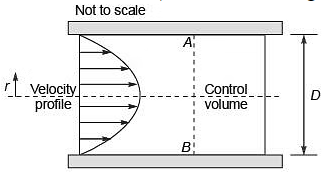
Consider steady, viscous, fully developed flow of a fluid through a circular pipe of internal diameter D. We know that the velocity profile forms a paraboloid about the pipe centre line, given by : m/s, where C is a constant. The rate of kinetic energy (in J/s) at the control surface A-B, as shown in the figure, is proportional to Dn. The value of n is ________.
Correct Answer :
Correct answer is : 8
Now,
∵ (a - b)3 = a3 – b3 – 3ab (a - b)
Solution :
The correct answer is 8.
Problem Analysis:
We are given a steady, viscous, fully developed flow of a fluid through a circular pipe of internal diameter D (and radius R = D/2). The velocity profile in terms of radial coordinate r is parabolic and given by:
where C is a constant. We need to find the power index n such that the rate of kinetic energy (kinetic energy flux) crossing the control surface A-B shown in the figure is proportional to Dn.
Step 1: Express velocity V in terms of radius R
Since the pipe radius is
, we can write:
Substituting this into the velocity profile:
Step 2: Formulate the rate of kinetic energy (kinetic energy flux)
Consider an elemental circular ring of radius r and thickness dr on the cross-section A-B. The area of this elemental ring is:
The mass flow rate through this ring is:
The rate of kinetic energy (K.E.) associated with this mass flow is:
Step 3: Integrate over the entire pipe cross-section
Integrating from r = 0 to r = R:
Substituting the expression for V:
Step 4: Solve the integral
Using u-substitution, let:
Then:
Changing the limits of integration:
Using the minus sign to flip the integration limits:
Step 5: Determine proportionality in terms of D
Substituting
:
This clearly shows that:
Comparing this to the given relation , we find:
Access expert-curated educational resources and study materials—completely free.
Create, conduct, and manage professional online assessments with Mindyard. Perfect for teachers and institutes.
Copyright © 2026 Mindyard. All Rights Reserved.