Consider the depicted hydrogen (H) in the hydrocarbons given below. The most acidic hydrogen (H) is
Options
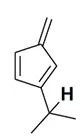
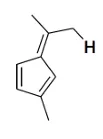
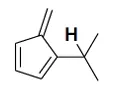
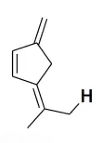
Correct Answer :
Solution :
The correct option is Option B.
To determine the most acidic hydrogen, we must evaluate the stability of the conjugate base (carbanion) formed after the removal of the proton as shown below:
The more stable the resulting carbanion (), the more acidic the corresponding hydrogen atom. Let's analyze the structures and the stability of their respective conjugate bases:
1. Option A (Image 0):
This structure shows a fulvene derivative with an isopropyl substituent at the bottom position of the ring, with the hydrogen labeled H on the isopropyl carbon. Removing this tertiary allylic proton yields a tertiary carbanion. While the negative charge is allylic to the ring, it cannot be delocalized into the ring to form a fully aromatic ring system because of structural conjugation constraints.
2. Option B (Image 1):
This structure shows a fulvene derivative where the exocyclic double bond is attached to a methyl group containing a hydrogen labeled H, represented as:
When this proton is removed, the negative charge on the resulting carbanion can delocalize via resonance through the exocyclic double bond into the cyclopentadiene ring. This resonance forms a cyclopentadienyl anion inside the ring, which has:
electrons. Since the ring is planar, cyclic, and fully conjugated with 6 pi-electrons, it satisfies Hückel's rule:
(where ). This aromatic stabilization of the conjugate base makes this hydrogen exceptionally acidic.
3. Option C (Image 2):
This structure contains an isopropyl substituent with a tertiary hydrogen labeled H. Deprotonation yields a localized tertiary carbanion that lacks aromatic stabilization.
4. Option D (Image 3):
This structure has a hydrogen labeled H on a methyl group attached to an exocyclic double bond. However, the conjugation pathway through the ring to the second exocyclic double bond does not yield a stable, aromatic cyclopentadienyl anion ring system.
Thus, the hydrogen in Option B is the most acidic due to the aromatic stabilization of its conjugate base.
Access expert-curated educational resources and study materials—completely free.
Create, conduct, and manage professional online assessments with Mindyard. Perfect for teachers and institutes.
Copyright © 2026 Mindyard. All Rights Reserved.